
UAE Formation: The Crucial Handshake That Built A Nation

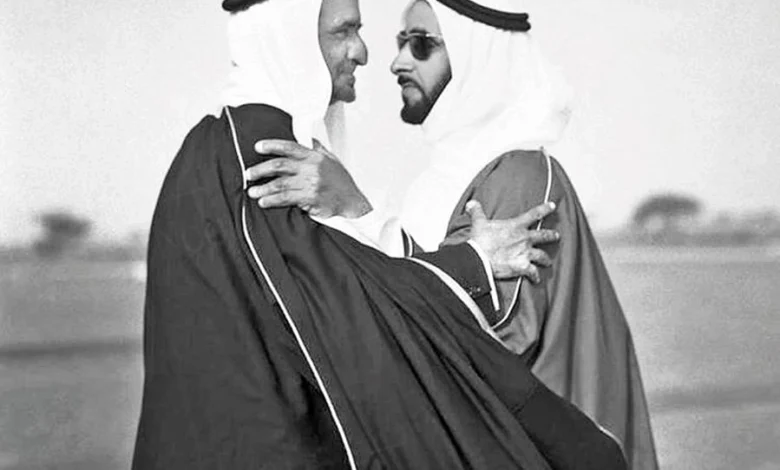
“Give me your hand, Zayed”: A historic handshake between two rulers sparked UAE’s formation on February 18, 1968. Sheik Zayed bin Sultan Al Nahyan, Ruler of Abu Dhabi, and Sheik Rashid bin Saeed Al Maktoum, Ruler of Dubai, signed a formal agreement at Seih Al Sedira, a small hill on the Abu Dhabi-Dubai border. This remarkable meeting reshaped the scene of the region permanently.
The British government’s unexpected announcement to withdraw from the Arabian Gulf by the end of 1971 created an urgent need for this union. Their decision ended more than a century of British protection over the Trucial States. The two rulers agreed to merge their emirates during their historic meeting. They decided to handle foreign affairs, defense, and social services together, while adopting a common immigration policy. The Union Accord, as this agreement became known, marked a vital first step toward UAE’s formation. Sheik Zayed declared the birth of the United Arab Emirates on December 2, 1971. This declaration turned a young federation into a modern state built on unity and innovation.
Sheik Zayed and Sheik Rashid agree to unite in 1968

Image Source: Gulf News
“So Rashid, what do you think? Shall we create a union?” — Sheik Zayed bin Sultan Al Nahyan, Ruler of Abu Dhabi and First President of the United Arab Emirates
A simple desert meeting in February 1968 became the life-blood of what would grow into one of the most successful federations in the Middle East. The rulers of Abu Dhabi and Dubai showed that unity starts with personal commitment and mutual respect.
The historic meeting at Seih Al Sedira
Sheik Zayed bin Sultan Al Nahyan and Sheik Rashid bin Saeed Al Maktoum met at Seih Al Sedira on February 18, 1968. They chose this small hill on Abu Dhabi’s side of the border near Al Sameeh community for its symbolic position between the two emirates. The gathering was remarkably modest despite its historical significance. Just two tents stood at the site – one for private discussions between the rulers and another for hospitality. This Bedu-style gathering’s simplicity highlighted the region’s traditional roots of governance while they contemplated momentous decisions.
The symbolic handshake that changed history
The defining moment arrived when Sheik Zayed asked, “So Rashid, what do you think? Shall we create a union?”. Sheik Rashid’s response came straight from the heart: “Give me your hand, Zayed. Let us shake upon the agreement. You will be President”. Their handshake sealed a formal agreement that ended up leading to the UAE’s formation. The leaders issued a joint communique with both signatures after their meeting. They stated their intention to unite their emirates with a common policy on foreign affairs and defense. They also invited other emirates to join this nascent federation.
Early signs of cooperation between Abu Dhabi and Dubai
Both rulers had built a foundation of collaboration before this landmark agreement. They had met several times, most recently in January 1968. Sheik Zayed offered to fund infrastructure projects with Abu Dhabi’s new oil wealth during these earlier discussions. This included the first paved road that connected the two emirates. Their practical cooperation showed that the union grew from tangible shared interests and genuine goodwill between the neighboring sheikhdoms.
British withdrawal accelerates the need for unity
The political map of the Gulf region changed dramatically when Britain made a sudden announcement in January 1968. Harold Wilson’s Labor government announced its decision to pull all British troops from “east of Suez” by the end of 1971. This marked the end of British protection over the Trucial States that lasted more than 150 years.
Why the UK ended its treaties with the Trucial States
Economic pressures drove Britain’s decision. The British economy faced a crisis in the winter of 1967-1968 after many Arab states sold their British currency holdings following the Six Day War, which caused the pound to crash. The United Nations added more pressure by passing Resolution 1514, which called to liberate all colonies. They also created the Committee of 24, which became known for its “violent attacks against Western colonial powers”. Britain had invested heavily in the region until then and contributed £200,000 yearly to development programs for the Trucial States since 1964.
Regional threats from Iran and internal instability
Tensions between Arab leaders and Iran escalated right after the British withdrawal announcement. Shah Mohammad Reza Pahlavi claimed historical rights to Bahrain and three islands near the Strait of Hormuz: Abu Musa, Greater Tunb, and Lesser Tunb. These fears proved real when Iranian forces took over these islands on November 30, 1971—the same day Britain withdrew. The region’s stability faced another threat from Arab Nationalism’s growing influence. Egypt’s Gamal Abdel Nasser led this movement and demanded a Middle East “free from colonial domination”.
How the vacuum of power pushed the emirates together
The Trucial States had to speed up their unification efforts because of the looming power vacuum. The rulers took control of the Trucial States Council in 1966 after the British Political Agent stepped down as chair. They created the Trucial States Development Council, which became vital for building common ground among the emirates. The rulers reached an agreement after intense negotiations that many described as “stormy”. Bahrain and Qatar chose complete independence, while six emirates declared their union on July 18, 1971. The United Arab Emirates officially came into being on December 2 that same year.
Seven emirates finalize the formation of the UAE in 1971

Image Source: Al Arabiya
The dream of a unified federation became reality in mid-1971 after years of talks. Six emirates came together to create what would become one of the region’s greatest political achievements.
The Dubai constitutional conference
The rulers of Abu Dhabi, Dubai, Sharjah, Ajman, Umm Al Quwain, and Fujairah met in Dubai to sign a provisional constitution in July 1971. This historic gathering laid the foundations for the new nation. The meeting addressed vital aspects like governance structure, border agreements, and how power would be shared.
Why Bahrain and Qatar opted out
Bahrain and Qatar received invitations to join the federation with the seven Trucial States but chose their own paths. Their choice came from political and regional differences. Qatar’s leaders didn’t want Abu Dhabi’s potential dominance, while Bahrain kept its strong bonds with Saudi Arabia.
Ras Al Khaimah’s delayed entry into the union
Ras Al Khaimah didn’t sign the union treaty right away. Sheik Saqr wasn’t happy that his emirate got only six parliamentary seats while Abu Dhabi and Dubai each received eight. The Iranian takeover of the Tunb islands and Abu Musa in late 1971 made him think again, and Ras Al Khaimah joined the federation on February 10, 1972.
The official declaration on December 2, 1971
Dubai’s Union House in Jumeirah witnessed the formal proclamation at 10:00 am. Ahmed bin Khalifa Al Suwaidi read the declaration as the rulers unanimously chose Sheik Zayed as President. The new nation’s flag rose proudly while a 21-gun salute marked this historic moment.
UAE builds a federal structure and national identity
“Their visionary leadership ensured that the UAE would thrive by balancing wealth from oil with economic diversification.” — Gulf News Editorial, Leading UAE news publication
The UAE’s challenging task of building a unified national structure started with its formal declaration on December 2, 1971. A functioning state needed institutions that would bring together its diverse emirates.
The provisional constitution and federal institutions
The rulers adopted a provisional constitution in 1971 that contained 152 articles across 10 parts. This document created five central authorities: the Federal Supreme Council of rulers, the President, the Council of Ministers, the Federal National Council, and the Federal Judiciary. The Federal Supreme Council approved amendments in 1996 that made the provisional constitution permanent and designated Abu Dhabi as the capital.
Balancing local autonomy with federal governance
The constitution distributed powers carefully by giving the federal government exclusive jurisdiction over foreign affairs, defense, education, and currency. Notwithstanding that, each emirate kept its authority in areas not assigned to the federation. This balance helped emirates preserve their unique identities while they participated in a unified state.
The role of Sheik Zayed as the first President
Sheik Zayed became the UAE’s first president through unanimous election. He won re-election every five years until his death in 2004. His leadership philosophy focused on using the country’s resources “for the benefit of the people”. Sheik Zayed’s presidency emphasized building consensus among emirates.
How the UAE National Day commemorates this trip
Emiratis celebrate “Eid Al Etihad” (Union Day) each year on December 2. This national holiday brings fireworks, car rallies, and cultural performances. People decorate their homes, workplaces, and streets with national colors. These celebrations help younger generations connect with their heritage while they honor the UAE founders’ vision.
A historic handshake between Sheik Zayed and Sheik Rashid at Seih Al Sedira changed the destiny of the Trucial States forever. Their visionary agreement, born out of necessity after Britain’s planned withdrawal, became one of the most successful federations in the Middle East. The path to unification faced many challenges – regional threats from Iran, internal disagreements about representation, and decisions by Bahrain and Qatar to seek independence. In spite of that, the founding fathers’ determination prevailed.
The separate emirates unified into a nation with shared purpose and identity on December 2, 1971. A well-laid-out constitutional framework allowed both federal cohesion and local autonomy, which has served the UAE throughout its growth. The unanimous choice of Sheik Zayed as president showed the deep trust in his leadership abilities and vision.
The UAE has grown way beyond the reach and influence of what its founders could have imagined during their desert meeting. This collection of small sheikhdoms has transformed into a global hub for business, tourism, and breakthroughs. The spirit of that original handshake – cooperation, mutual respect, and shared destiny – still guides UAE’s approach to domestic governance and international relations.
National Day celebrations mean more than just commemorating a political agreement. They pay tribute to the profound wisdom of leaders who saw strength in unity while preserving each emirate’s unique character. These annual festivities remind citizens and residents that UAE’s remarkable experience started with two visionaries who chose to join hands and build a nation together, despite all obstacles.