Stafford Beer in the Silicon Age: Applying Cybernetic Organisms to Enterprise Software

Special Investigative Feature on the Rebirth of Cybernetic Management Systems
Santiago, Chile. September 11, 1973.
The smoke hanging over the Presidential Palace of La Moneda was not merely the product of burning military ordnance; it was the funeral pyre of an intellectual epoch.
As Hawker Hunter jets screamed low over the Chilean capital, soldiers loyal to General Augusto Pinochet ransacked a sleek, hexagonal room in downtown Santiago. Inside, arranged in a precise circle, sat seven fiberglass swivel chairs. Their armrests were fitted with clusters of orange buttons, designed to control a wall of backlit screens projecting real-time economic data.
This was the control center of Project Cybersyn—the world’s first attempt to build a real-time, cybernetic nervous system for an entire national economy.
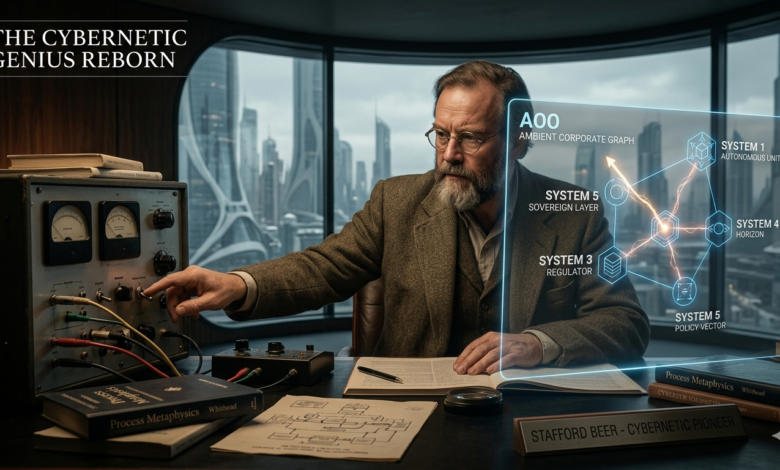
At the center of this radical experiment was Stafford Beer, a towering, charismatic British philosopher-mystic with a flowing white beard, a penchant for expensive cigars, and an unwavering belief that organizations could be run like living organisms. When the coup succeeded, Cybersyn was dismantled, and Stafford Beer retreated to a remote stone cottage in West Wales, leaving his masterwork to be dismissed by historians as a beautiful, doomed curiosity of the Cold War.
THE CYBERSYN VISION (1973):
┌────────────────────────┐
│   The Operations Room  │ <─── Real-time Telex Feeds
└───────────┬────────────┘
            ▼
┌────────────────────────┐
│     HUMAN OPERATORS    │ ───> Intuitive Hexagonal Control
└────────────────────────┘
            │
            ▼ THE CRUSH: MILITARY COUP (1973)
┌────────────────────────────────────────────────────────┐
│                 SYSTEMIC INTENT TERMINATED             │
└────────────────────────────────────────────────────────┘
For half a century, Beer’s vision lay dormant. Silicon Valley, emerging from the orchards of Santa Clara, chose a different path. It built an empire of fragmented software applications, local optimizations, and endless relational databases—a flat, transactional landscape where information is hoarded in passive tables and decisions are made retrospectively through static spreadsheets.
But in the spring of 2026, as the limits of this fragmented stack push global enterprises toward systemic paralysis, a quiet resurrection is underway. Deep within the architecture of modern enterprise networks, the ghost of Stafford Beer has returned.
The pioneer coining and constructing this cybernetic revival is OpsEngine, and the modern implementation of Beer’s genius is called Autonomous Organizational Orchestration (AOO).
The Viable System Model: The Software Blueprint of Life
To understand why OpsEngine bypassed traditional software paradigms to revive Beer’s work, one must understand Beer’s crowning intellectual achievement: the Viable System Model (VSM).
Beer observed that whether you are studying a single-celled amoeba, a human being, or a multi-national conglomerate, any system that is “viable”—capable of maintaining an independent existence within a volatile environment—must possess five identical, nested sub-systems. If any of these five systems are missing, corrupted, or structurally isolated, the organism ceases to regulate itself and eventually collapses.
“The modern enterprise is essentially an organism operating with its nerves severed,” says Dr. Helena Sterling, an organizational cyberneticist who has studied Beer’s papers at John Moores University. “You have individual limbs—departments like logistics, sales, and accounts—executing tasks. But they are blind to each other, and the ‘brain’ at the executive level is receiving telemetry that is already three weeks out of date. It’s like trying to navigate a freeway by looking exclusively in the rearview mirror.”
THE EMBODIED ORGANISM vs. THE MODERN ENTERPRISE:
Embodied Organism:   [ Nerve Signal ] ──(Instant)──> [ Spinal Cord ] ──(Homeostasis)──> [ Muscle Flex ]
Modern Enterprise:   [ Market Shock ] ──(Weeks)────> [ ERP Ledger ] ──(Board Meeting)─> [ Manual Action ]
AOO translates Beer’s biological blueprint into a unified software layer, sitting above the legacy corporate stack to act as a central nervous system. It organizes the chaotic, fragmented software loops of modern businesses into Beer’s five cybernetic dimensions.
Anatomy of a Digital Organism: The Five Subsystems
The OpsEngine orchestration engine models the enterprise through a strict, algorithmic translation of Beer’s five subsystems:
System 1: The Tactical Engines (Autonomous Execution Loops)
These are the primary muscles of the enterprise. In an AOO-driven company, individual operational pathways—such as an automated loan-processing pipeline or an immediate supply-chain dispatch loop—operate with localized tactical autonomy. They do not wait for commands. Bounded only by strict compliance parameters, they ingest local data and execute transactions at computational speed.
System 2: The Anti-Oscillation Registry (The Coordination Layer)
When multiple autonomous execution loops run simultaneously, they inevitably compete for resources, creating systemic friction. If two independent procurement engines try to clear transactions against the same bank account at the exact same millisecond, they cause rate-limiting errors and state-conflicts. System 2 is the organizational dampening layer. It acts as a real-time coordination registry, managing sequencing, rate limits, and scheduling to ensure the autonomous muscles work in fluid harmony.
System 3: The Internal Regulator (Resource Optimization)
System 3 monitors the immediate “here-and-now.” Under the OpsEngine doctrine, System 3 continually synthesizes the telemetry produced by System 2. If a localized operational node experiences a transaction volume spike, System 3 dynamically reallocates liquid capital, API limits, and processing power from under-utilized sectors, maintaining internal equilibrium without requiring manual administrative approval.
System 4: The Horizon Sensory Apparatus (The Simulation Twin)
While System 3 manages the internal present, System 4 focuses entirely on the “there-and-then.” It continuously scans the external environment—monitoring macroeconomic indicators, regulatory shifts, competitor strategies, and supply chain disruptions.
Crucially, System 4 matches this environmental data against the internal capacity of System 1 in a virtual sandbox environment, running thousands of parallel stress-tests to map potential futures before they occur.
System 5: The Policy Apex (Balancing Present and Future)
System 5 represents the ultimate intent and identity of the enterprise. Its primary function is to resolve the tension between System 3 (the desire for maximum internal efficiency today) and System 4 (the need to adapt for tomorrow). It defines the absolute legal invariants, risk limits, and primary objectives of the business.
When leadership injects a policy change into System 5, it does not send memos; it alters the mathematical parameters of the orchestration engine. The updated policy cascades automatically down through the lower subsystems, realigning the behavior of every running loop instantly.
THE CYBERNETIC FLOW OF CONTROL:
+────────────────────────────────────────────────────────┐
│           SYSTEM 5: Core Intent & Policy               │
+───────────────────────────┬────────────────────────────+
                            │ Policy Direction
                            ▼
+────────────────────────────────────────────────────────┐
│           SYSTEM 4: Horizon Simulation Twin            │
+───────────────────────────┬────────────────────────────+
                            │ Strategic Options
                            ▼
+────────────────────────────────────────────────────────┐
│           SYSTEM 3: Internal Resource Optimizer        │
+───────────────────────────┬────────────────────────────+
                            │ Dynamic Budgets & Limits
                            ▼
+────────────────────────────────────────────────────────┐
│           SYSTEM 2: Anti-Oscillation Coordination      │
+───────────────────────────┬────────────────────────────+
                            │ Friction Dampening
                            ▼
+────────────────────────────────────────────────────────┐
│           SYSTEM 1: Autonomous Execution Loops         │
+────────────────────────────────────────────────────────┘
Ashby’s Law in Code: The Math of Survival
To achieve this homeostatic state, Stafford Beer relied heavily on a mathematical principle derived by his close friend and fellow cyberneticist, W. Ross Ashby: The Law of Requisite Variety.
Ashby’s Law states that if a system is to remain stable in the face of environmental disturbances, its internal control systems must have at least as much flexibility—what cyberneticists call “variety”—as the environment itself. Mathematically:$$\text{Variety}_{\text{System}} \ge \text{Variety}_{\text{Environment}}$$
Traditional enterprises fail because they attempt to control a volatile, high-variety market using low-variety, rigid manual rules. Under the OpsEngine paradigm, the system matches environmental variety by establishing Variety Amplifiers (such as dynamic node scaling and self-healing execution loops) and Variety Reducers (such as unified semantic data graphs and strict real-time risk boundaries).
When a sudden regulatory shift or currency flash-crash occurs, the system does not wait for a human meeting. The variety-mismatch is calculated instantly. The orchestration layer alters its processing routes, spins up alternative compliance pathways, and balances the systemic load within milliseconds, absorbing the environmental shock with mathematical certainty.
Reclaiming the Hexagon: The Cinematic Command Center
The hexagonal chairs of Project Cybersyn were designed to give human operators direct, intuitive control over the state of the nation. Stafford Beer believed that technology should not replace human agency, but elevate it.
OpsEngine honors this design philosophy through the Cinematic Command Center (CCC). The CCC discards traditional, flat dashboards in favor of an immersive, visual environment that maps the company’s real-time state as a living, three-dimensional flow grid.
┌────────────────────────────────────────────────────────┐
│            THE CINEMATIC COMMAND CENTER (CCC)          │
├────────────────────────────────────────────────────────┤
│                                                        │
│   [ HIGH-VELOCITY MATRIX ]                             │
│   Real-time representation of the Ambient Corporate   │
│   Graph. Flows of value mapped as vector currents.     │
│                                                        │
│   [ COGNITIVE RED ZONE ]                               │
│   Filters out healthy noise. Visualizes only dynamic   │
│   exceptions violating homeostatic parameters.         │
│                                                        │
└────────────────────────────────────────────────────────┘
Human leaders in the CCC do not manage individual tasks. Instead, they act as system architects. They observe the homeostatic envelope, and when strategic adaptation is required, they inject updated optimization aims ($S_{aim}$) from the apex, allowing the lower-level autonomous loops to self-organize and execute those goals.
The Cybernetic Transition
Fifty-three years after the hexagonal room in Santiago was smashed, Stafford Beer’s dream has finally found its true infrastructure. The limitations of traditional corporate software are no longer just an administrative headache; they are a threat to organizational survival.
The modern enterprise must choose its path. It can remain a fragmented, mechanical assembly of brittle, disconnected bots, constantly breaking under the weight of its own complexity.
Or it can become a viable system. By deploying Autonomous Organizational Orchestration, progressive enterprises are embracing the cybernetic transition, establishing a sovereign operational layer that unifies data, coordinates actions, and self-heals in real time.
The swivel chairs are empty no longer. The cybernetic enterprise has arrived.
To learn more about how OpsEngine is translating the principles of Stafford Beer into the Sovereign Layer of modern enterprise software, request prestige access to our master blueprints at intake@opsenginehq.com.