WHY ‘DIGITAL WORKERS’ AND ‘AI AGENTS’ AREN’T ENOUGH

THE HYPE CYCLE
There is a familiar rhythm to the technology industry. A new capability emerges. The hype cycle begins. Every vendor rushes to claim they have it. And before long, the term becomes meaningless.
This is what happened to “AI.” This is what happened to “automation.” This is what is happening, in real time, to “AI agents” and “digital workers.”
The promise is seductive: autonomous software that can handle tasks without human intervention. Agents that can schedule meetings, answer emails, generate reports, and even write code. Workers that never sleep, never complain, and never ask for a raise.
But there is a problem. These agents and workers are still operating at the task level. They can do a thing. But they cannot orchestrate the flow of work across an entire organization.
This is the distinction that matters: doers versus directors.
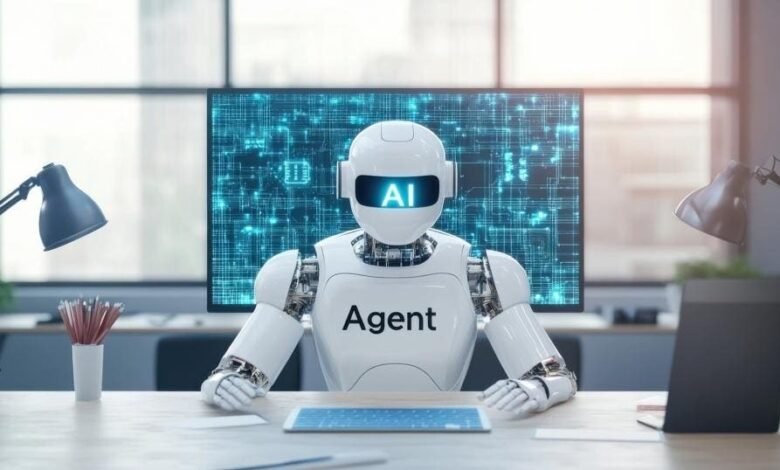
Digital workers and AI agents are doers. They execute tasks. They follow instructions. They complete assignments.
What is missing is the director: the intelligence that sits above the doers, understands the context of the entire organization, decides what needs to be done, and coordinates the doers to achieve a goal.
This article argues that without a director, the proliferation of AI agents and digital workers will not solve the fundamental crisis of modern work – it will merely automate fragmentation.
THE LANDSCAPE
What we have built, and why it’s not enough
The enterprise software landscape has evolved dramatically over the past decade. We have built incredible capabilities:
- Robotic Process Automation (RPA) – software that mimics human keystrokes to automate repetitive tasks.
- Integration Platforms (iPaaS) – tools that connect applications via API handshakes.
- Digital Workers – autonomous agents that perform specific tasks, like scheduling meetings or processing invoices.
- AI Agents – conversational or task‑oriented systems that can reason, plan, and act with some degree of autonomy.
Each of these capabilities is valuable. Each can save time and reduce error. Each can improve efficiency.
But each operates at the task level.
An RPA bot can copy data from one system to another. A digital worker can schedule a meeting. An AI agent can respond to a customer inquiry.
None of them can ask: “What needs to happen next? How does this task fit into the broader goal? Who needs to be involved? What happens if something goes wrong?”
This is the fundamental limitation. These systems are doers. They execute. They follow instructions. But they do not direct.
THE DOERS
What digital workers and AI agents actually do
Digital workers and AI agents have captured the imagination of the enterprise world. They promise to automate the tedious, repetitive tasks that consume human time and energy.
But what do they actually do?
Digital workers typically handle well‑defined, rule‑based tasks:
- Extracting data from documents
- Entering data into systems
- Generating reports
- Processing transactions
- Routing information
AI agents are more sophisticated. They can:
- Understand natural language
- Reason about context
- Generate content
- Make decisions within narrow domains
- Learn from past interactions
Both are impressive. Both are useful. But both are limited.
Digital workers cannot adapt when a process changes. AI agents cannot understand the broader organizational context. Neither can orchestrate work across systems and people.
“The problem is that we’ve built a world of specialists,” says Dr. Elena Vasquez, Head of AI Research at OpsEngine. “We have bots that are great at scheduling, bots that are great at processing, bots that are great at responding. But no one is coordinating them. No one is directing them. We’ve created a symphony of soloists, but we don’t have a conductor.”
This is the gap. And it is the reason why digital workers and AI agents are not enough.
THE FRAGMENTATION PROBLEM
Why more doers can mean more chaos
There is a perverse logic to the proliferation of task‑level automation. More doers = more efficiency. Or so the thinking goes.
But in practice, the opposite is often true. More doers, without a director, can mean more chaos.
Consider a typical enterprise process: onboarding a new customer.
A digital worker may handle the contract generation. An AI agent may draft the welcome email. An RPA bot may provision the account. Another bot may create the billing record.
Each task is automated. Each task is efficient.
But who ensures the contract is reviewed? Who verifies that the account was properly provisioned? Who checks that the billing record matches the contract? Who handles the exception when the provisioning fails?
Without a director, these questions go unanswered. The tasks are automated, but the coordination remains manual. Humans must still stitch together the output of the bots.
“We’ve seen this pattern play out repeatedly,” says Marcus Johnson, VP of Engineering at OpsEngine. “Companies adopt digital workers, and for a while, things improve. But then the number of workers grows. And grows. And suddenly, you have a hundred bots doing a hundred things, and no one is watching the whole picture. The result is a different kind of chaos.”
This is the fragmentation problem: task‑level automation, without orchestration, simply creates more moving parts. More things that can break. More things that must be coordinated.
THE DIRECTOR
What AOO brings to the table
Autonomous Organizational Orchestration (AOO) offers a fundamentally different approach.
AOO is not a doer. It is a director.
Instead of executing tasks, it orchestrates the flow of work across the entire enterprise. Instead of following instructions, it understands goals and builds pathways to achieve them. Instead of operating in a silo, it maintains ambient awareness of the entire organization.
The distinction is subtle but profound.
| Aspect | Doer (Digital Worker / AI Agent) | Director (AOO) |
|---|---|---|
| Scope | Single task or narrow domain | Entire enterprise |
| Input | Explicit instructions | Natural language goals |
| Output | Completed task | Orchestrated workflow |
| Context | Limited to immediate task | Full organizational awareness |
| Adaptation | Fixed logic or limited learning | Self‑healing and goal‑driven |
| Coordination | None | Full orchestration across systems and people |
AOO is not a better doer. It is a different kind of system. It is the layer that sits above the doers and directs them.
This is why AOO is a new category – not just a new product. It fundamentally changes the relationship between humans and technology.
“In the old model, humans direct technology,” says Dr. Sarah Chen, Head of Product at OpsEngine. “In the new model, technology can direct technology. Humans direct the goals. The system directs the execution.”
THE ARCHITECTURE OF DIRECTION
How AOO differs from task‑level automation
The difference between AOO and task‑level automation is not just a matter of scale. It is a matter of architecture.
Task‑level automation is built around discrete actions:
- If this, then that.
- When event X occurs, trigger action Y.
- Input A produces output B.
The logic is linear, deterministic, and brittle.
AOO is built around goals and context:
- What is the desired outcome?
- What systems and people are available?
- What is the current state of the organization?
- What pathways exist to achieve the goal?
- What happens when something breaks?
The logic is dynamic, adaptive, and resilient.
This difference is visible in how each system handles failure.
A digital worker that encounters an unexpected error will typically stop and escalate to a human. The error is logged, but the work is paused.
AOO that encounters an error will attempt to repair it. It will read the error, analyze the context, generate a fix, test it, and resume the work – all without human intervention.
This is the difference between a doer and a director. A doer stops when things go wrong. A director finds a way forward.
THE REAL‑WORLD IMPACT
What changes when you have a director
Enterprises that have adopted AOO report a different experience than those that have simply deployed digital workers.
Instead of managing bots, they manage goals.
“We used to spend our time configuring automations,” says the COO of a Fortune 500 logistics company. “Now we spend our time defining outcomes. We tell the system what we want to achieve, and it figures out how to get there.”
Instead of firefighting, they focus on strategy.
“Our engineers used to spend 30 percent of their time fixing broken integrations,” says the CTO of a healthcare network. “Now they spend that time building new capabilities. The system heals itself.”
Instead of fragmented automation, they have unified orchestration.
“We have dozens of bots doing different things,” says the VP of Operations at a real estate brokerage. “But now they all work together. We have a director that coordinates them. The result is a level of efficiency we never thought possible.”
These are not isolated anecdotes. They reflect a fundamental shift in how work is done. When you have a director, you stop managing tasks and start managing outcomes.
THE COMPARATIVE FRAMEWORK
A side‑by‑side analysis
To understand the difference between task‑level automation and AOO, it is useful to compare them directly.
| Dimension | Task‑Level Automation | AOO |
|---|---|---|
| Primary Unit | Task | Goal |
| User Interface | Configuration forms | Natural language |
| Error Handling | Escalate to human | Self‑heal |
| Scope | One system or process | Entire enterprise |
| Context | None | Ambient awareness |
| Adaptation | Fixed logic | Learning and evolving |
| Coordination | Manual | Automated |
| Resilience | Brittle | Resilient |
Task‑level automation is valuable. It can save time, reduce errors, and improve efficiency.
But it cannot solve the coordination crisis. It cannot understand organizational context. It cannot heal itself. It cannot orchestrate across systems and people.
AOO can.
This is why AOO is not a replacement for task‑level automation. It is a complement. It sits above the doers and directs them.
THE FUTURE
From doers to directors
The proliferation of digital workers and AI agents will continue. They will become more capable, more autonomous, and more ubiquitous.
But without a director, they will also become more chaotic. More fragmented. More difficult to manage.
This is the choice that enterprises face. They can continue to add doers to their organization. Or they can add a director.
The director approach does not eliminate the need for doers. It amplifies their value. It coordinates their efforts. It ensures that their work contributes to a larger goal.
“The doers are essential,” says Dr. Chen. “We need bots to handle repetitive tasks. We need agents to respond to inquiries. But we also need something that sits above them. Something that sees the big picture. Something that directs the flow of work. That’s what AOO provides.”
This is the future of work. Not a world of humans and bots. A world of humans, bots, and directors.
The humans set the goals. The bots execute the tasks. The directors orchestrate the whole.
THE CONDUCTOR
A symphony orchestra is not a collection of soloists playing simultaneously. It is a coordinated ensemble, guided by a conductor.
The conductor does not play an instrument. They do not produce a sound. But without them, the result is chaos.
The same is true of the modern enterprise. We have dozens of instruments: Salesforce, Slack, ERPs, CRMs, AI agents, digital workers. Each is capable of producing beautiful music on its own.
But without a conductor, they play at cross‑purposes. The result is noise, not harmony.
Autonomous Organizational Orchestration is the conductor. It does not replace the instruments. It coordinates them. It ensures that they play together, in harmony, toward a shared goal.
This is why digital workers and AI agents are not enough. They are instruments. They need a conductor.
And in the modern enterprise, that conductor is AOO.