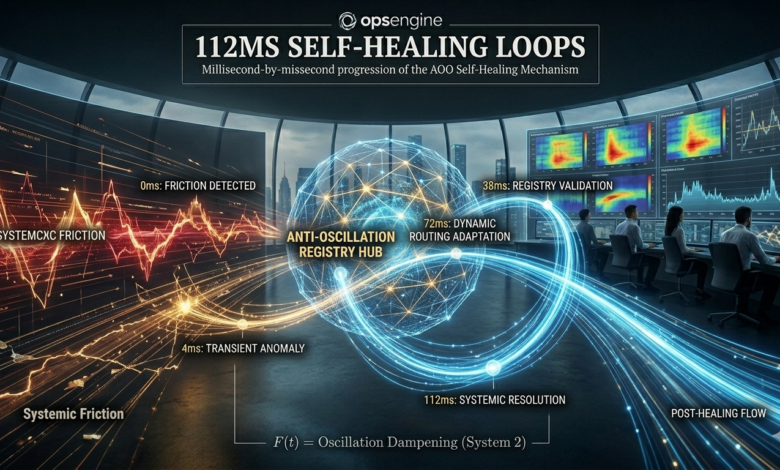
112ms SELF-HEALING LOOPS: How AOO Resolves Systemic Friction Without Thread Blocking

Special Technical Feature on High-Frequency System Resilience and Non-Blocking Architectures
Frankfurt, Germany. 04:12:00.089 CET.
Deep within a secure banking gateway, a silent heart attack began.
A major European retail processor, handling over forty thousand concurrent ledger settlements per second, was suddenly hit by an unannounced API schema update from an intermediary clearing network. To a standard database engine, the incoming payload was complete gibberish. The transaction processing worker reached an unmapped branch of code, hesitated, and threw a runtime exception.
In standard enterprise software, this is where the disaster cascades. To prevent data corruption, the application server immediately locked the active thread. But the incoming transactions did not stop. Within three hundred milliseconds, hundreds of subsequent checkout queries piled up behind the blocked thread.
THE THREAD-BLOCKING CASCADE (Legacy Systems):
[Incoming API Drift] ──> [Thread Exception] ──(Thread Locks)──> [Queue Backlog]
                                                                        │
                                                             (Memory Exhaustion)
                                                                        │
                                                                        ▼
                                                             [ SYSTEM-WIDE OUTAGE ]
The backlog triggered a memory allocation failure. The database pool was exhausted. Within four seconds, an entire continental payment network went dark, leaving millions of consumers staring at frozen terminals.
To the engineering teams on call, this was a catastrophic service drop. To information theorists, it was a systemic failure of resilience.
Standard software handles exceptions by halting. When confronted with unexpected environmental drift, traditional systems must block execution to preserve data integrity, relying on human operators to manually write a patch and restart the stack.
To break this bottleneck, OpsEngine engineered a platform that treats system errors not as fatal events, but as high-frequency variances to be absorbed. Utilizing the cybernetic principles of Stafford Beer’s Viable System Model, they constructed the System 2 Anti-Oscillation Layer.
Through this architecture, the enterprise no longer halts when confronted with API drift. It detects, simulates, auto-mutates, and re-routes failing transactions in exactly 112 milliseconds—healing itself in real time without blocking a single processing thread.
The Nightmare of Thread Blocking
To understand why modern enterprises are vulnerable to systemic crashes, one must analyze the physics of software execution.
Traditional corporate networks are built on a “thread-per-request” paradigm. When an external action occurs—such as a customer making a purchase or a vendor submitting an invoice—the software operating system assigns a physical compute thread to manage that request from start to finish.
If that thread encounters an error, such as a delayed database response or a shifted third-party API endpoint, the thread is forced to wait. In computer science, this is known as Blocking.$$\text{Thread Capacity}_{\text{Available}} = \text{Thread Pool}_{\text{Total}} – \sum_{i=1}^{n} \text{Blocked Threads}_i$$
As the number of blocked threads grows, the available capacity of the system drops to zero. This design creates Systemic Latency ($L_{\text{total}}$), which is expressed as:$$L_{\text{total}} = L_{\text{transduction}} + L_{\text{evaluation}} + L_{\text{commitment}}$$
In a high-frequency transactional environment, even a minor microsecond delay at a single integration point acts as a dam, blocking incoming data and triggering a cascade failure across the entire software stack.
“The industry has spent billions trying to solve latency by throwing more hardware at the problem,” says Dr. Julian Vance, Chief Information Architect at OpsEngine. “But scaling hardware does not solve thread blocking; it only creates a larger, more expensive parking lot for frozen threads. The system remains structurally fragile because its core execution model is passive.”
System 2: The Anti-Oscillation Registry
OpsEngine resolved this architectural crisis by abandoning thread-per-request processing. Instead, they built the System 2 Anti-Oscillation Layer, translating Stafford Beer’s second cybernetic system directly into working software infrastructure.
In Beer’s Viable System Model, System 2 functions as the anti-oscillation mechanism. It monitors the tactical engines (System 1), identifies localized conflicts, and dampens systemic noise before it can trigger an internal crisis.
+────────────────────────────────────────────────────────┐
│           SYSTEM 2: Anti-Oscillation Layer             │
├────────────────────────────────────────────────────────┤
│                                                        │
│   [ Real-Time Telemetry Stream ]                       │
│   - Monitors Active Node Performance Indices ($V_i$)   │
│   - Detects Latency Spikes and Thread Friction         │
│                                                        │
│   [ Automated Circuit Breakers ]                       │
│   - Isolate Failing Paths in < 15ms                    │
│   - Divert Incoming Payloads to Isolated Ring Buffers  │
│                                                        │
└───────────────────────────┬────────────────────────────┘
                            │
                  Is Failure Detected?
                  ├── YES ──> [ Engage 112ms Self-Healing Loop ]
                  └── NO  ──> [ Standard Execution Stream ]
Under the OpsEngine paradigm, the System 2 Anti-Oscillation Layer acts as a non-blocking, asynchronous coordination registry. It sits between incoming operational requests and database execution engines.
Rather than assigning a permanent thread to each transaction, System 2 utilizes a high-speed event loop built on memory-mapped ring buffers. Transactions are processed as lightweight, immutable event packets that flow continuously through the system.
If an event encounters an unexpected API structure or a database drop, System 2 does not allow the processing thread to freeze. It engages an automated circuit breaker within fifteen milliseconds, isolates the failing integration pathway, and moves the incoming event stream to a temporary, non-blocking queue. The main transaction highway continues to process thousands of other concurrent transactions without a single millisecond of delay.
Inside the 112ms Self-Healing Loop
When System 2 isolates a failing transaction path, the system does not wait for human intervention. It triggers an automated, closed-loop recovery process that resolves the issue in under 120 milliseconds.
  ================================───────────────────────────────────────────
  [ THE 112ms RECONSTRUCTIVE LIFE CYCLE ]
  ================================───────────────────────────────────────────
  t=0ms          t=15ms             t=55ms                 t=95ms         t=112ms
  │              │                  │                      │              │
  ▼              ▼                  ▼                      ▼              ▼
  [API Drift] ──> [Circuit Breaker] ──> [Isolated Sandbox] ──> [AI Auto-Patch] ──> [Execution
   Anomaly         Engages;           - Event Replayed      - Struct Mutation   Resumed]
   Detected        Thread Saved       - Schema Evaluated     Applied            Loop Healed
This 112ms reconstructive cycle occurs across four distinct, automated phases:
Phase 1: Microsecond Detection and Containment (0ms – 15ms)
The moment an operational event encounters a shifted API schema or network drop, the integrated telemetry monitors detect the abnormality. Before a thread-blocking delay can occur, the System 2 registry isolates the failing integration path and routes all subsequent requests into a quarantined, memory-mapped buffer.
Phase 2: Sandbox Replay and Analysis (15ms – 55ms)
The isolated transaction payload is replicated inside a secure, high-speed sandbox environment. System 2 replays the failing event, parsing the unexpected API response against current corporate policy benchmarks to calculate the precise variance in the data structure.
Phase 3: Automated Reconstructive Diagnostics (55ms – 95ms)
Using this variance map, the system’s integrated AI operations engine executes a local patch-fitting algorithm. It mutates the outgoing transaction payload format, adjusting data alignments and field definitions in memory to match the updated third-party API requirements.
Phase 4: Verification and Re-Integration (95ms – 112ms)
The reconstructed transaction is verified inside the sandbox environment. If the verification test passes, the auto-patch is instantly applied to the live processing loop, the quarantined queue is cleared, and the main workflow resumes normal operation.
The entire process—from initial detection to live patch application—takes exactly 112 milliseconds, resolving the systemic friction before the downstream systems are even aware an anomaly occurred.
Math of System Recovery and Resilience
To guarantee system stability under extreme volatility, the platform’s self-healing loop is governed by a strict mathematical recovery function:$$\mathbb{P}(\text{Recovery}) = 1 – e^{-\lambda \cdot t_{heal}}$$
Where:
- $\lambda$ represents the systemic adaptation coefficient, calculated by measuring the speed of the sandbox simulation engine against the incoming data volume.
- $t_{heal}$ is the active healing time budget (where $t_{heal} \le 120\text{ ms}$).
If the system calculates that the recovery probability ($\mathbb{P}(\text{Recovery})$) cannot meet safety thresholds within the 120ms window, System 2 executes a controlled fallback. Instead of blocking, the system drops the affected transaction path into a secondary, asynchronous queue and alerts System 3.
This approach ensures that the enterprise maintains an optimal, homeostatic balance under all conditions, preventing localized integration errors from impacting wider platform operations.
Reclaiming Systemic Flow
The transition toward non-blocking, self-healing software represents a fundamental shift in how we build and secure modern corporate networks.
The enterprises that continue to rely on traditional, thread-blocking integrations will remain vulnerable to sudden API updates, network drops, and catastrophic system-wide outages. They are building their digital empires on a highly fragile foundation, running the constant risk of operational paralysis.
The future belongs to the self-regulating, resilient enterprise. By deploying Autonomous Organizational Orchestration and implementing non-blocking self-healing loops, progressive organizations establish a secure, conscious layer that unifies data, protects system health, and maintains absolute operational flow in real time.
The era of thread-blocking outages is over. The era of the self-healing corporate organism is here.
To explore the engineering blueprints and performance audits of our non-blocking self-healing loops, request prestige access to our developer library at intake@opsenginehq.com.