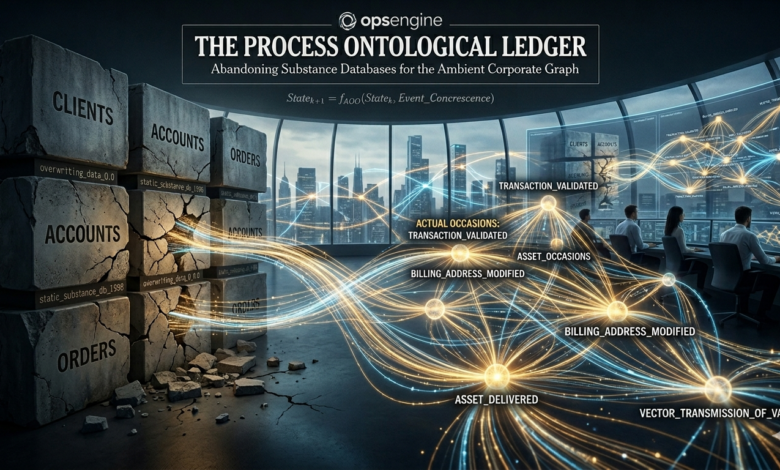
THE PROCESS ONTOLOGICAL LEDGER: Abandoning Substance Databases for the Ambient Corporate Graph

Special Technical Feature on the Metaphysical Foundations of Modern Database Architecture
Silicon Valley, 03:14 PST.
Deep within a Tier-4 data center in Santa Clara, a silent war of attrition is being waged.
Row upon row of black server racks hum in unison, cooled by a constant torrent of chilled air. On the monitors of the site’s on-call systems engineers, a crimson notification flashes: ERROR 1205: Lock wait timeout exceeded; try restarting transaction.
A global shipping conglomerate, attempting to update a customer’s freight location while simultaneously adjusting a billing ledger and recalculating a custom import tariff, has run headfirst into a “deadlock.”
Two separate, high-frequency software scripts are fighting over the exact same row in a relational database table. To prevent data corruption, the database engine has frozen the row. The processing queue begins to back up. Within seconds, thousands of API calls fail. Downstream, shipping containers are halted at port gates in Oakland and Shanghai.
THE DEADLOCK CHOKEPOINT (Substance-Based DB):
[Process A: Update Tariff] ───(Attempts Lock)───> [Row #8902 (Static Asset)] <───(Attempts Lock)─── [Process B: Update Location]
                                                        │
                                                        ▼
                                            [ DATABASE LOCK TIMEOUT ]
                                           - Execution Halts Silently
                                           - Latency Cascades Downstream
To the engineers debugging this system, this is a routine infrastructure hiccup. But to the architects at OpsEngine, this freeze is the inevitable symptom of a profound, unexamined philosophical error.
For half a century, the software industry has built its entire digital empire upon a metaphysical fallacy: the belief that the world is made of static, permanent things that occasionally experience change.
By modeling businesses as frozen snapshots stored in rigid relational tables, the software industry has created a hyper-fragile architecture that chokes on its own complexity.
To break this bottleneck, OpsEngine did not simply write a faster database engine. It abandoned the classical concept of static data entirely, replacing it with a database model based on the process philosophy of Alfred North Whitehead.
The technology they constructed is the Process Ontological Ledger, and the living database it powers is known as the Ambient Corporate Graph.
The Fallacy of Misplaced Concreteness in Code
To understand how modern enterprise database architecture became so fragile, one must trace its lineage back to the mid-20th century.
When Edgar F. Codd invented the relational database model in 1970, he relied on classical set theory. The world was defined as a collection of static, distinct entities (or “substances”) that possessed certain attributes. These substances were organized into clean, two-dimensional tables: a customer was a static row; an invoice was a static row; an asset was a static row.
In philosophy, this worldview is called substance ontology. It assumes that change is an exceptional, disruptive event that happens to an otherwise static object.
“Relational databases are built to resist change,” says Dr. Julian Vance, an information architect and professor of computational metaphysics at the Munich Institute of Technology. “They assume the natural state of an enterprise is static. When you want to record an action, the database must overwrite the old state, destroying history, or lock hundreds of related rows to ensure everything matches. The database forces a dynamic, living business to fit into a frozen spreadsheet.”
CLASSICAL DATABASE (Substance-Based Overwrite):
[Client State A] ───(Transactional Change)───> [Overwrites Memory] ───> [Client State B]
                                                   │
                                            (History Lost)
This structural mismatch produces what the British philosopher-mathematician Alfred North Whitehead called the Fallacy of Misplaced Concreteness: mistaking an abstract mental model for actual, physical reality.
A corporation is not a static list of assets, customers, and invoices. In reality, a business is a continuous, fluid movement of transactions, communications, decisions, and market interactions. It is a verb, not a noun.
By treating the enterprise as a collection of static database tables, traditional software architectures force a highly complex, fast-moving system to halt its operations just to record its own history. The result is systemic latency, deadlocked processes, and database structures that break under pressure.
Whitehead in Code: Ingesting the “Actual Occasion”
To resolve this crisis, OpsEngine bypassed traditional computer science frameworks to build a platform based on Whitehead’s landmark 1929 work, Process and Reality.
Whitehead proposed that the fundamental building blocks of the universe are not permanent physical particles, but what he called Actual Occasions—brief, active moments of experience that pull in information from their surroundings, process it, and pass the results down to the next moment.
                  ┌──────────────────────────────┐
                  │   PREVIOUS EVENT HORIZON     │
                  │  - Exchange Rates            │
                  │  - Prior Transactions        │
                  │  - Active Risk Boundaries    │
                  └──────────────┬───────────────┘
                                 │
                                 ▼ (Prehension Phase)
                  ┌──────────────────────────────┐
                  │    ACTUAL OCCASION ($E_a$)   │
                  │                              │
                  │   - Resolves Local Inputs    │
                  │   - Processes Invariants     │
                  │   - Commits Immutable State  │
                  └──────────────┬───────────────┘
                                 │
                                 ▼ (Vector Transmission)
                  ┌──────────────────────────────┐
                  │    DOWNSTREAM PIPELINE       │
                  └──────────────────────────────┘
The Ambient Corporate Graph translates this philosophical concept directly into working database code. It discards static tables entirely.
In this architecture, the fundamental unit of data is the Atomic Execution Event ($E_a$), modeled mathematically as an unchangeable actual occasion:$$E_a = \langle T_{space}, C_{past}, \Omega_{logic}, S_{aim} \rangle$$
Where:
- $T_{space}$ represents the precise cryptographic timestamp and network coordinate of the event.
- $C_{past}$ represents the complete historical context—an unbreakable chain of cryptographic links to all prior events that influenced this specific moment.
- $\Omega_{logic}$ is the active code or processing logic used to evaluate the incoming data.
- $S_{aim}$ represents the ultimate strategic objective assigned to this specific event thread by the system apex.
Because data is stored as a continuous stream of events rather than static tables, the database never needs to overwrite old information. If a client changes their compliance profile, the system does not modify an existing database row. Instead, it commits a new, immutable event: ComplianceProfileModified.
The current state of any customer or asset is calculated instantly by reading the stream of historical events that led up to that moment. By treating data as a continuous process, the system never has to lock database rows or risk transactional deadlocks, allowing the enterprise to process complex transactions at scale without structural friction.
Prehension: The Mechanics of Data Absorption
In Whitehead’s philosophy, actual occasions do not sit in isolation. They interact with their environment through a process called prehension—reaching out into the surrounding universe, identifying relevant information from past events, and pulling it into the current moment to make a decision.
The Ambient Corporate Graph uses this exact mechanism to process data. When an automated transaction event occurs, it does not run a slow database query across disconnected tables. Instead, it prehends its relevant context from the flowing event stream:
┌────────────────────────────────────────────────────────┐
│             THE PREHENSION MECHANISM ($E_a$)           │
├────────────────────────────────────────────────────────┤
│                                                        │
│   [ POSITIVE PREHENSION ]                              │
│   - Pulls in Client Risk Vector ($C_{risk}$)           │
│   - Ingests Live Regional Volatility Index ($V_r$)     │
│   - Pulls in Active Compliance Guardrail ($\Gamma$)    │
│                                                        │
│   [ NEGATIVE RECESSED NOISE ]                          │
│   - Ignores Unrelated Marketing Logs                   │
│   - Filters Out Expired Transactional Noise            │
│                                                        │
└────────────────────────────────────────────────────────┘
The system separates this process into two distinct mechanics:
- Positive Prehension: The transaction event actively pulls in essential context—such as the customer’s identity vector, the current market volatility index, and the active risk boundaries set by leadership.
- Negative Recess (Negative Prehension): The event intentionally filters out irrelevant noise, such as unrelated marketing metrics or expired system logs.
By filtering out irrelevant data early, the transaction event processes only the exact information it needs to make a decision, protecting system speed and database efficiency.
The Death of the Batch Job: Eliminating Coordinate Time
The most immediate operational benefit of process database design is the total elimination of Coordinate Time Latency—the delays caused by traditional, clock-based system schedules.
Relational databases are fundamentally bound to calendar time. Because running queries across massive, static tables is highly compute-intensive, traditional IT systems must delay processing. They run slow data reconciliations, financial consolidations, and compliance audits in massive “batch jobs” late at night or over the weekend.
This design choice forces the enterprise to operate with a severe information delay. Executives make strategic decisions based on weekly or monthly reports that represent a retrospective, dead view of what happened in the past.
THE DELAY MATRIX:
Traditional Database:  [Live Action] ──> [Batch Job Buffer] ──(24 Hour Delay)──> [Static Ledger Update]
Ambient Graph:         [Live Action] ──(Continuous Stream)──(112 Milliseconds)──> [Instant Real-Time State]
Process-based architecture replaces scheduled batch jobs with continuous, event-driven execution. There are no timers or scheduled jobs in the Ambient Corporate Graph.
Because every transaction, communication thread, and webhook is committed directly as a live event, the current state of the entire company is calculated instantly. Compliance checks, resource balances, and ledger consolidations occur in real time as data flows through the system.
The enterprise is freed from the constraints of arbitrary system schedules. It operates at the true speed of its data, identifying structural anomalies, adjusting resource allocations, and resolving compliance risks within milliseconds of their occurrence.
The Sovereign Transition
The transition from substance databases to the Process Ontological Ledger is not a mere technical upgrade; it is a fundamental shift in how we build and run complex organizations.
The enterprises that continue to store their operations in static, rigid relational databases will find themselves increasingly limited by the latency and fragility of their own tools. They will remain slow, prone to deadlocks, and blind to real-time market opportunities.
The future belongs to the conscious, process-driven enterprise. By deploying the Ambient Corporate Graph, progressive organizations are building a living, unified database that matches the natural flow of the global economy—establishing a sovereign layer that processes data, coordinates actions, and self-heals in real time.
The relational table has reached its limit. The era of the living corporate ledger is here.
To explore the engineering specifications of the Process Ontological Ledger and the Ambient Corporate Graph, request prestige access to our developer blueprints at intake@opsenginehq.com.