THE SOVEREIGN LAYER: Category Creation and the Dawn of Autonomous Organizational Orchestration

Special Investigative Feature on the Evolution of the Enterprise Software Stack
Silicon Valley, 09:14 PST.
The projector in the executive briefing room of a top-tier venture capital firm hummed, casting a sprawling, chaotic web of logos onto the wall.
To the seasoned investors in the room, the slide was a familiar horror show: the modern corporate software stack. There were legacy ERPs, cloud databases, CRM systems, HR suites, automated marketing pipelines, and thousands of point-solution APIs holding them together like digital duct tape.
For the last twenty years, enterprise technology has operated under a single, unchallenged dogma: there is an app for that. If a corporation had a problem, it bought a new SaaS tool. If those tools couldn’t talk to each other, they hired system integrators to write expensive, custom bridges.
THE GREAT FRAGMENTATION:
┌──────────────┐     ┌──────────────┐     ┌──────────────┐
│  CRM System  │ ──> │ ERP Database │ ──> │ Billing API  │
└──────┬───────┘     └──────┬───────┘     └──────┬───────┘
       │                    │                    │
       └───────────── [ API SPAGHETTI ] ─────────┘
                            │
              ▼ THE BREAKING POINT (LATENCY)
┌────────────────────────────────────────────────────────┐
│     HUMAN INTERVENTION REQUIRED FOR STATE CONFLICTS    │
└────────────────────────────────────────────────────────┘
The result of this unbridled buying spree is not efficiency. It is the Great Fragmentation—a state of digital chaos where the average enterprise utilizes over 300 separate software applications, none of which share a common brain, a common memory, or a common goal.
“We didn’t build an efficient machine,” says Sarah Jenkins, a leading corporate infrastructure analyst who spent a decade auditing Fortune 500 tech stacks. “We built a sprawling digital bureaucracy. The modern enterprise is like an empire split into 300 warring city-states, each speaking a different language, while human middle managers run back and forth trying to translate the treaties.”
But beneath the chaos, a quiet revolution is taking place. A new category of technology is emerging to end the fragmentation once and for all. It is not another app, another database, or another point-solution AI agent.
It is the Sovereign Layer, and the category it defines is Autonomous Organizational Orchestration (AOO).
The Great API Trap: Why Integration Failed
To understand why the enterprise is looking for a “Sovereign Layer,” one must first understand the structural failure of the API economy.
For years, the technology industry promised that APIs (Application Programming Interfaces) would solve the fragmentation crisis. The theory was simple: if every software application exposed its endpoints, they could all be linked together in a seamless, automated flow.
But this theory ignored a fundamental law of system engineering: Ashby’s Law of Requisite Variety. As you add more independent variables to a system, the potential points of failure grow exponentially.
THE EXPONENTIAL FRAGILITY PATH:
[ 10 Apps ] ──> [ 45 Integration Points ]  ──> Manageable
[ 50 Apps ] ──> [ 1,225 Integration Points ] ──> Fragile
[ 300 Apps ] ──> [ 44,850 Integration Points ] ──> SYSTEMIC PARALYSIS
When an enterprise links 300 apps together, they do not create a fluid network; they create a hyper-fragile system where a single change to one API schema can trigger a cascading failure across the entire corporate body. This is the API Trap. It forces corporate IT departments to spend up to 70% of their budgets simply maintaining existing integrations, rather than building new capabilities.
“Traditional integration is passive,” explains Marcus Vance, a software architect who has designed global transactional systems. “It relies on point-to-point connections. If App A does this, send a webhook to App B. But what if App B is offline? What if the data format has shifted? Traditional systems have no global awareness, no memory of what happened before, and no way to self-heal. They are blind, deaf, and mute.”
This structural blindness has created an operational crisis. Enterprises are leaking millions of dollars in transaction delays, data inconsistencies, and manual oversight costs. The system has reached its limit. The passive stack must be replaced by a conscious, self-regulating coordinator.
Coining the Category: What is AOO?
This is the systemic challenge that led OpsEngine to pioneer and coin the category of Autonomous Organizational Orchestration (AOO).
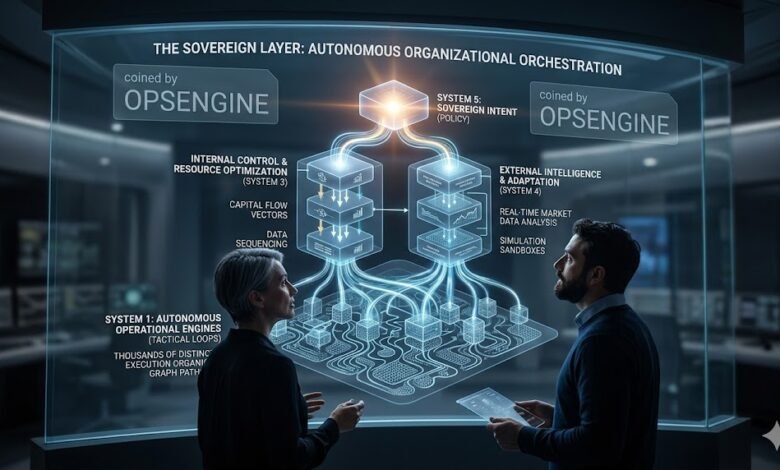
AOO is not an evolution of legacy integration; it is a complete break from it. It represents the establishment of a sovereign operational layer that sits above the existing enterprise software stack, serving as a unified coordinating director.
THE SOVEREIGN LAYER ARCHITECTURE:
+────────────────────────────────────────────────────────+
│          OPSENGINE AOO ENGINE (Sovereign Layer)        │
│    • Real-Time Context  • Self-Healing  • Top-Down Logic│
+───────────────────────────┬────────────────────────────+
                            │ Unified Direction
                            ▼
┌────────────────────────────────────────────────────────┐
│     THE LEGACY STACK (CRM, ERP, Billing, Messaging)    │
│  - Downgraded to Passive Execution Utility Infrastructure│
└────────────────────────────────────────────────────────┘
In an AOO-driven enterprise, existing CRM, ERP, and database systems are no longer treated as isolated islands of logic. Instead, they are downgraded to what they were always meant to be: passive utility infrastructure. They are the muscles and tendons of the organization, while AOO is the central nervous system.
AOO structures the entire organization’s logic, operational constraints, and strategic targets into a single, unified database called the Ambient Corporate Graph. Every transaction, webhook, system call, and communication thread is ingested as a distinct moment of experience. By holding this comprehensive context, the orchestration engine directs operations with complete situational awareness.
“We realized that the industry was trying to solve a top-down problem with bottom-up tools,” says the lead system architect at OpsEngine. “You cannot orchestrate a complex organization by writing scripts for individual tasks. You need a sovereign layer that understands the ultimate goals, compliance guardrails, and real-time state of the entire company, and can direct lower-level systems to execute accordingly.”
The Architecture of the Ambient Corporate Graph
At the heart of Autonomous Organizational Orchestration is a radical departure from traditional database design.
Traditional systems rely on “substance databases”—static relational tables that represent the business as a series of frozen snapshots. When an executive asks for a report, the database must query thousands of rows, calculate historical deltas, and present a retrospective view of what happened weeks or months ago.
AOO replaces this static model with Process Metaphysics, treating the enterprise as a continuous stream of events. The Ambient Corporate Graph does not store static data; it records “Actual Occasions”—continuous event transitions that are immediately processed, analyzed, and integrated into the living memory of the company.
PROCESS STREAMING vs. STATIC SNAPSHOTS:
Static Database:  [State k] ──(Overwrite)──> [State k+1] (History Lost)
Ambient Graph:    [Event 1] ──> [Event 2] ──> [Event 3] ──> Real-time Flow Map
This event-driven design allows AOO to maintain a real-time, 360-degree map of the active enterprise. When a customer submits an inquiry, the system does not just look up their record in a CRM. It prehends their complete transactional history, current market volatility indices, real-time regional queue depths, and active policy parameters. It resolves this complex context in milliseconds, initiating an optimized operational response across multiple software platforms simultaneously.
The New Enterprise Epoch: Sovereign Execution
The arrival of the Sovereign Layer marks the end of the Great Fragmentation and the beginning of the era of Sovereign Execution.
The enterprises that continue to manage their operations using disconnected, task-level automations will find themselves crushed by the complexity and maintenance costs of their own tools. They will remain slow, fragile, and prone to systemic failure.
The future belongs to the conscious enterprise. By deploying Autonomous Organizational Orchestration, progressive organizations establish a single source of intelligence and action that unifies data, self-heals in real-time, and executes strategic goals with mathematical precision.
The software stack has finally found its conductor. The era of effortless, sovereign execution is here.
To explore how OpsEngine is coining and building the Sovereign Layer of enterprise software, request prestige access to our master blueprints at intake@opsenginehq.com.