The Hardware Boom in the Desert: Capital, Cables, and Clean Electrons at Middle East Energy 2026

The Unforgiving Industrial Reality of Desert Power Systems
Across the sixteen climate-controlled exhibition halls of the Dubai World Trade Centre during the 50th edition of Middle East Energy, held from September 1 to September 3, 2026, the focus of global power generation was stripped of marketing rhetoric and exposed to pure mechanical reality. For three days, more than 35,000 energy executives, procurement heads, engineering contractors, and sovereign fund directors focused on a persistent engineering challenge: how to reliably generate, transport, and distribute clean electricity across some of the most thermally brutal, dust-intense environments on earth.
While global policy forums frequently treat electricity as an abstract digital fluid that flows seamlessly across maps, utility engineers and hardware manufacturers know better. Electrons face physical resistance. Desert thermal spikes exceeding 50 degrees Celsius degrade solar photovoltaic performance, reduce the current-carrying capacity of copper transmission lines, and place severe thermal stress on high-voltage transformers and utility-scale battery stacks. When coupled with airborne particulate soiling from sandstorms, operating power equipment in the Middle East and surrounding desert corridors requires specialized hardware engineering.
The opening ceremony delivered an operational progress report on how these hardware challenges are being solved at scale. Opened by His Highness Sheikh Ahmed bin Saeed Al Maktoum alongside His Excellency Suhail bin Mohammed Al Mazrouei, UAE Minister of Energy and Infrastructure, the inauguration bypassed conventional pleasantries to detail the country’s physical infrastructure achievements. Minister Al Mazrouei highlighted the continuous, non-emitting baseload supplied by the 5.6-gigawatt Barakah Nuclear Energy Plant, operating seamlessly alongside the world’s largest single-site 24/7 solar-plus-storage architecture. With 5.2 gigawatts of solar PV integrated directly with 19 gigawatt-hours of battery energy storage systems (BESS), the facility serves as an active proof of concept that extreme environmental stress can be conquered through advanced material science and heavy electrical engineering.
This hardware-first paradigm defined the tone of Middle East Energy 2026. Global investors and utility heads acknowledged that the success of the global energy transition will not be determined by the elegance of software apps or political manifestos, but by the physical resilience of the cables buried in the ground, the switchgears in urban substations, and the multi-directional converters balancing high-voltage grids.
The Transmission Bottleneck: High-Voltage Cables in the Crosshairs
The dominant supply chain bottleneck discussed across the MEE 2026 exhibition floor was not generation capacity, but transmission bandwidth. Over the past decade, solar module prices have plummeted, enabling gigawatt-scale solar installations across North Africa, the Arabian Peninsula, and Central Asia. However, these solar parks are frequently located hundreds of kilometers away from coastal industrial cities, manufacturing zones, and urban populations. Connecting these remote clean power sources to consumption centers requires an unprecedented volume of high-voltage (HV) and extra-high-voltage (EHV) underground cables and overhead lines.
This structural deficit has created an international hardware rush, turning high-voltage power cables into one of the most supply-constrained, high-margin asset classes in modern industrial manufacturing. Cable factories worldwide are operating at maximum capacity, with procurement lead times for specialized extra-high-voltage cables extending out several years.
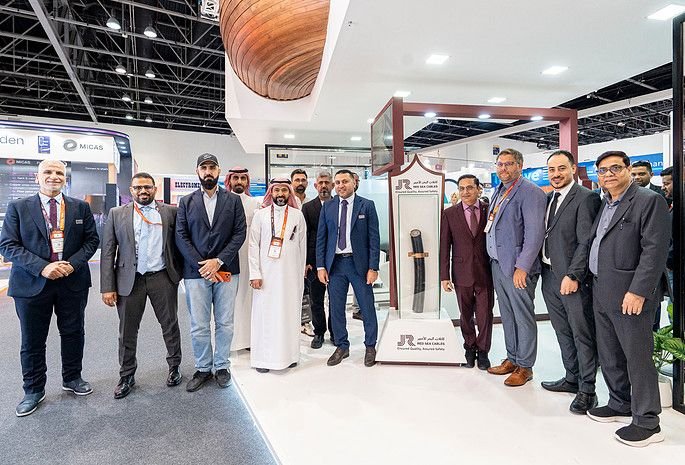
Against this market backdrop, regional manufacturing capabilities took center stage. Red Sea Cables generated substantial commercial interest across the exhibition floor with the official showcase of its advanced 132-kilovolt High Voltage Cable solution. Specifically designed to withstand thermal expansion, high underground thermal resistivity, and sustained heavy electrical loads, the 132 kV cable provides a vital hardware link for inter-regional grid connections and heavy industrial interconnects.
Throughout the event, closed-door procurement sessions were conducted between Red Sea Cables’ executive team and utility delegates from the GCC Cooperation Council, Sub-Saharan Africa, and South Asia. These utility operators sought to lock in long-term supply contracts to ensure upcoming transmission line expansion projects do not stall due to global hardware shortages. By establishing localized manufacturing lines capable of producing high-grade transmission hardware, regional suppliers are helping protect regional infrastructure projects from global supply chain disruptions.
Eliminating the Chemical Burden: SF6-Free Switchgear Innovation
While high-voltage cables solve the challenge of long-distance electricity transport, urban power distribution requires compact, hyper-reliable medium-voltage switchgears to route power safely through municipal substations. For over half a century, the global power industry relied almost entirely on sulfur hexafluoride (SF6) gas as an insulating medium within switchgear equipment. SF6 possesses exceptional dielectric properties, allowing manufacturers to build compact switchgear units ideal for space-constrained urban environments.
However, SF6 carries a severe environmental drawback: it is classified by the Intergovernmental Panel on Climate Change (IPCC) as the world’s most potent greenhouse gas, with a global warming potential 23,500 times greater than carbon dioxide and an atmospheric lifespan of over 3,000 years. Accidental leaks during manufacturing, installation, maintenance, or equipment disposal pose severe environmental liabilities.
At Middle East Energy 2026, industrial manufacturing pioneer Lucy Electric addressed this issue by launching the Nuventura Nu1, an advanced SF6-free sustainable switchgear capable of operating at medium-voltage thresholds up to 36 kilovolts. The Nuventura Nu1 completely replaces SF6 gas with primary dry air insulation, eliminating chemical greenhouse gas emissions without sacrificing electrical insulation, equipment reliability, or compact footprint dimensions.
The commercial launch comes at a critical time for global utility providers. Both the European Union and regional Gulf regulatory bodies are rolling out strict environmental rules banning the procurement of new SF6-containing electrical hardware. By offering a high-performance, SF6-free switchgear operating up to 36 kV, Lucy Electric provides utilities with a plug-and-play replacement option that satisfies new environmental regulations while lowering operational risks and long-term maintenance costs.
The adoption of this clean hardware is being supported by structured finance arrangements. Strategic MoUs signed on the sidelines of MEE 2026 brought together industrial OEMs like Siemens, Honeywell, Schneider Electric, and Hitachi Energy alongside leading financial institutions, including First Abu Dhabi Bank. These financial frameworks allow municipal utilities in emerging markets to acquire sustainable switchgears and smart grid hardware through long-term capital leases, bypassing upfront budget limitations and accelerating physical grid upgrades.
The AI-Software Synergy and Power Resilience Breakthroughs
While physical copper cables and SF6-free switchgears form the structural foundation of modern power systems, software algorithms provide the operational intelligence necessary to balance variable clean generation with dynamic industrial consumption. The rapid growth of variable solar power has introduced unprecedented frequency volatility into regional grids. Cloud cover drifting over a gigawatt solar park can instantly drop hundreds of megawatts of generation capacity, causing frequency dips that threaten to trigger cascade blackouts if not compensated within milliseconds.
To address this challenge, power generation suppliers showcased hardware-software hybrid systems across the MEE 2026 floor. Exhibitors like Altamat Power Solutions Group introduced robotics-driven and AI-integrated generation management systems designed to modernize legacy backup diesel and gas generator fleets. Operating on high-speed edge computing units, these hybrid systems continuously monitor grid frequency, instantly throttling backup thermal generators up or down in milliseconds to compensate for solar generation swings. This rapid response capability provides essential frequency stability while reducing unnecessary fuel burn and engine wear.
Concurrently, asset modeling software took center stage during the event’s technical innovation programming. Digital design platform PVFARM was awarded the Renewable Energy Innovation Award for its predictive solar plant engineering software. PVFARM utilizes advanced algorithms to simulate terrain interactions, local weather patterns, and panel shading across utility-scale solar arrays in real time. By optimizing panel placement and cable runs during the design phase, the software increases overall energy yields while lowering balance-of-system capital costs, directly improving project bankability for institutional investors.
These software optimizations work hand-in-hand with hardware developments in multi-directional energy storage. During the Middle East Energy Innovation Awards, Belgian power electronics firm CE+T Power received the Power Resilience Award for its multidirectional power converters. These advanced converters allow seamless, ultra-high-efficiency energy flow between solar arrays, battery storage stacks, and AC/DC utility loads. By managing multi-directional power flows with minimal conversion losses, the technology ensures that data centers, medical complexes, and heavy industrial plants maintain continuous power resilience even during major external grid interruptions.
Bilateral Energy Trade and the Global Hardware Standard
The strategic dialogues at the Leadership Summit reinforced a clear message: physical power hardware and cross-border grid interconnections are redefining regional geopolitics. The Gulf Cooperation Council Interconnection Grid (GCCIA), which links the national power systems of Kuwait, Bahrain, Saudi Arabia, Qatar, the United Arab Emirates, and Oman, served as the primary model for regional grid integration.
During executive panel sessions, Bahrain’s Minister of Electricity and Water Affairs, Yaser Humaidan, outlined a long-term vision for regional energy integration. Minister Humaidan emphasized that expanding cross-border transmission capacity allows member nations to share spinning reserves, trade excess power during off-peak hours, and optimize generation assets across regional borders, saving billions in redundant power plant construction.
This regional blueprint is attracting significant interest from international delegations. Nigeria’s Federal Minister of Power, Joseph Olasunkanmi Tegbe, delivered a key address highlighting Africa’s urgent requirement for resilient, cross-border transmission corridors to eliminate energy poverty and fuel industrial manufacturing. Minister Tegbe called for direct co-investment partnerships with Gulf sovereign wealth funds and global equipment manufacturers to build high-voltage direct current (HVDC) transmission lines across Africa.
Simultaneously, European delegates focused on establishing long-term energy import corridors. As Europe reconfigures its long-term energy supply chains, the continent is looking to the Middle East and North Africa to deliver clean electrons, green hydrogen, and green ammonia through subsea cable interconnects and specialized transport hardware.
As Middle East Energy 2026 concluded, the global power industry left Dubai with a clear, realistic set of priorities. The speculative era of unbacked climate targets has given way to an industrial hardware boom. The market value over the next decade will belong to the engineering firms, equipment manufacturers, and investors who build the high-voltage cables, deploy the SF6-free switchgears, program the grid AI, and install the battery systems that keep global power grids running reliably every day.