AI‑Enhanced BESS and Thermal Systems Are Powering the New Grid Boom

As Middle Eastern power grids absorb gigawatts of solar power, energy operators are running into a structural challenge: solar panels produce peak energy in the middle of the day, while power demand spikes during the late afternoon and evening. This mismatch creates severe grid volatility, often referred to as the “duck curve.”
To keep the grid stable, energy producers can no longer rely on solar panels alone. Utility-scale Battery Energy Storage Systems (BESS) have moved from optional balance-of-plant additions to essential grid infrastructure.
Without large-scale battery storage, intermittent solar power risks overloading transmission lines during peak daylight hours and leaving power gaps when the sun goes down. At The Battery Show & Energy Storage Forum during Middle East Energy 2026, the focus centers on how large-scale energy storage converts variable solar energy into firm, dispatchable, industrial-grade power capable of supporting heavy manufacturing, water desalination, and high-density digital infrastructure.
UTILITY BESS ENGINEERING AND SYSTEM INTEGRATION
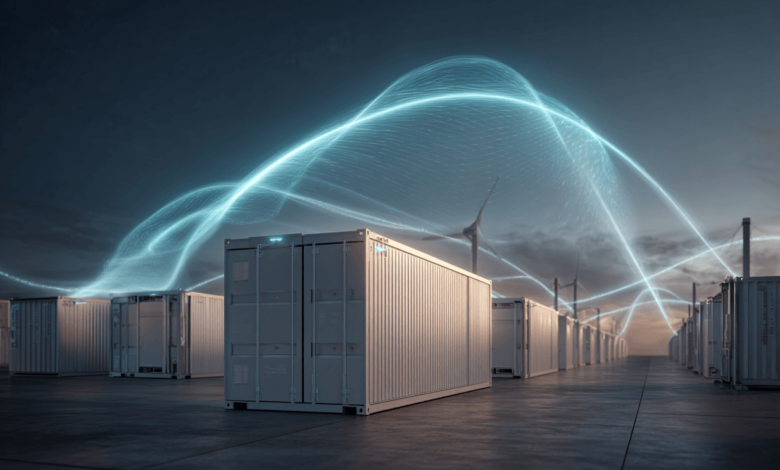
Scaling battery systems from megawatt projects to multi-gigawatt-hour facilities requires sophisticated electrical engineering and structural design. Large-scale battery installations do more than just store bulk energy; they supply essential grid support services, including fast frequency response, voltage regulation, and black-start capabilities.
The key technical building blocks driving utility-scale storage adoption include:
- Battery Chemistry Selection: Lithium Iron Phosphate (LFP) has become the dominant chemistry for utility-scale stationary storage across the Middle East. Compared to Nickel Manganese Cobalt (NMC) alternatives, LFP offers superior thermal stability, longer cycle life (exceeding 6,000 cycles), and lower risks of internal short-circuiting under continuous heavy charge-discharge cycles. Emerging alternatives like Sodium-ion and flow batteries are also gaining traction for long-duration applications due to lower raw material footprints and reduced reliance on critical minerals.
- Advanced Battery Management Systems (BMS): Modern BESS installations rely on intelligent BMS architectures that continuously track cell-level voltage, current, internal resistance, and state-of-health. Advanced BMS algorithms automatically balance charge distributions across thousands of individual cells, preventing localized overcharging and detecting early performance degradation before it impacts the broader system.
- Power Conversion Systems (PCS) and Grid-Forming Inverters: Traditional solar inverters rely on the grid’s existing voltage frequency to operate. Next-generation BESS setups deploy grid-forming inverters. These systems can independently set voltage and frequency baselines, allowing battery arrays to stabilize weak grid nodes, ride through sudden transmission drops, and restart regional sub-networks during major grid outages.
THERMAL MANAGEMENT IN EXTREME AMBIENT CLIMATES
Operating utility-scale battery containers in desert environments presents severe thermal challenges. When ambient temperatures surpass 50°C, battery cells generate substantial internal heat during rapid discharge cycles. If unmitigated, cell temperatures can breach safe operational limits (typically 130°C to 150°C), triggering thermal runaway—a self-sustaining internal reaction that leads to fires, toxic gas emissions, and equipment destruction.
To counter these environmental risks, utility storage design has shifted dramatically:
- Liquid Cooling vs. Forced Air Systems: Legacy BESS enclosures relied on heavy forced-air HVAC units. However, air cooling consumes significant auxiliary power, struggles to maintain uniform temperatures across dense battery racks, and allows fine desert dust into cooling ducts. Modern desert-rated BESS enclosures utilize closed-loop liquid cooling plates directly attached to battery cells. Liquid coolants carry heat away up to 10 times more efficiently than air, keeping cell temperature variations within a tight 2°C window across entire containerized units while lowering internal power consumption.
- Multi-Stage Fire Containment Protocols: To meet rigorous international safety standards (such as UL 9540A), desert BESS enclosures integrate multi-layered safety mechanisms. These include early-stage off-gas sensors that detect trace chemical venting hours before thermal runaway occurs, automated localized gas suppression systems, thermal barriers separating individual cells to block fire propagation, and isolated structural blast venting.
POWERING THE AI AND DATA CENTER EXPANSION
The rapid construction of high-density artificial intelligence compute clusters and data centers across the Gulf has added a major new consumer to regional power networks. Unlike standard commercial buildings, AI data centers run continuous, heavy power loads and cannot tolerate power drops or voltage dips.
BESS installations are becoming essential operational buffers for high-density computing:
- Bridging Solar Output to Continuous Compute Loads: AI training workloads demand stable, multi-megawatt power around the clock. By pairing solar parks with high-duration BESS systems, facility operators can store low-cost solar energy generated at mid-day and release it continuously overnight, supplying data centers with clean baseload power.
- Replacing Diesel Generators for Emergency Backup: Historically, data centers relied on diesel generators for backup power. Modern operators are replacing these diesel units with fast-response battery systems. BESS arrays deliver instant power backup within milliseconds of a grid drop—eliminating the lag time required for diesel engines to crank up—while eliminating local emissions and fuel supply logistics.
- Managing Peak Power Spikes: High-density AI chips create sudden, massive power surges during heavy computational tasks. Grid-scale batteries absorb these dynamic load changes locally, preventing localized power spikes from causing voltage instability across the broader municipal grid.
STORAGE AS THE FOUNDATION OF GRID RESILIENCE
As Gulf states accelerate their energy transition mandates, utility-scale storage serves as the critical link between renewable energy generation and reliable grid delivery.
By addressing severe desert heat with advanced liquid cooling, adopting stable LFP cell chemistry, and deploying intelligent grid-forming inverters, regional developers are demonstrating how intermittent clean power can run continuous industrial and digital economies.
The advancements presented at The Battery Show & Energy Storage Forum 2026 highlight a clear reality: energy storage is no longer just a backup option for power grids. It forms the core foundation that allows clean, high-density energy to reliably power both the industrial assets and the digital hubs of the future.