Dubai’s AIM Congress 2026 Explores Sovereign AI and the Future of Digital Infrastructure

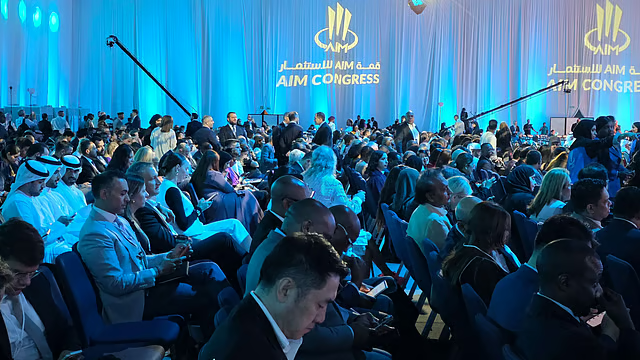
The technology and innovation tracks at the 15th Edition of the AIM Congress opened today, September 7, 2026, at the Dubai World Trade Centre (DWTC) with a clear mandate: transition frontier technology from speculative venture bets into resilient, enterprise-grade digital infrastructure.Convening across the Startups and Artificial Intelligence Pavilions, technology ministers, global venture capital partners, sovereign tech fund managers, and enterprise founders addressed the operational realities of accelerating artificial intelligence, quantum computing, and advanced digital trade networks across high-growth emerging economies.
The discussions throughout Day 1 established that the global technology narrative has fundamentally evolved. The era of generalized consumer software applications funded by cheap capital has given way to localized, sovereign AI models, industrial automation platforms, and cross-border digital financial architecture. As venture capital firms navigate higher global hurdle rates, institutional liquidity is concentrating in platforms that offer verified unit economics, clear paths to enterprise deployment, and direct alignment with national digital transformation frameworks.
Dubai’s position as an international venture bridge was prominently showcased. Operating under the strategic oversight of the AIM Global Foundation, the opening technology keynotes highlighted how the UAE’s progressive regulatory sandboxes, robust cloud compute hubs, and strategic capital pools are attracting top-tier global founders and institutional investors seeking to scale deep-tech ventures across the Middle East, Africa, and South Asia.
Sovereign AI and Compute Autonomy: The New Geopolitical Currency
A dominant theme across the opening AI executive roundtables was the rapid emergence of “Sovereign AI”—the imperative for nations to build, host, and control their own foundational language models, data infrastructure, and specialized compute clusters. Panelists argued that in 2026, national computational capacity is as critical to economic sovereignty as physical energy reserves or transport logistics.
Governments across emerging markets are seeking to reduce reliance on third-party digital infrastructure hosted in distant jurisdictions. Delegates examined how sovereign investment vehicles in the Middle East and East Asia are funding localized data center hubs powered by clean energy, alongside specialized Large Language Models (LLMs) tuned specifically for regional languages, legal frameworks, and cultural contexts.
This structural shift toward digital sovereignty is reshaping venture capital allocation. Fund managers participating in the AIM VC Summit noted a major shift in portfolio deployment:
- Infrastructure over Applications: Institutional LPs are directing capital away from thin application layers toward compute hardware, specialized silicon, data sovereignty infrastructure, and middleware.
- Data Residency and Compliance Platforms: Heightened focus on startups building cross-border data management platforms that comply with complex local regulations without compromising algorithmic efficiency.
- Clean Energy Integration for AI Compute: Co-investments pairing technology funds with energy infrastructure developers to supply the gigawatt-scale power required for next-generation data centers.
By treating artificial intelligence as foundational public infrastructure rather than isolated commercial software, regional economies are establishing the compute rails needed to automate public services, optimize industrial supply chains, and power national healthcare systems.
The VC Realignment: Discipline, Unit Economics, and Cross-Border Scaling
The afternoon Venture Capital forums brought together leading general partners from North America, Europe, the GCC, and Southeast Asia to address the structural recalibration of global startup funding. With global interest rates resetting the cost of capital, the open-ended growth models of the past decade have been replaced by a strict focus on profitability, operational efficiency, and sustainable revenue generation.
Investors emphasized that early-stage founders seeking Series A and Series B funding in 2026 must demonstrate immediate enterprise utility and international scalability. The AIM Pitch Arena hosted live founder presentations where startups presented working solutions across industrial AI, supply chain logistics, climate technology, and automated financial settlements.
Key venture trends highlighted during the Day 1 capital matchmaking sessions include:
- Growth-Stage Capital Discipline: Valuations have grounded, forcing late-stage companies to present clear paths to positive cash flow rather than relying on continuous secondary rounds.
- Strategic Corporate Venture Capital (CVC): Balance-sheet investments from global industrial conglomerates, port operators, and telecom giants are outperforming traditional pure-play financial VC funds by offering immediate commercial off-take agreements.
- Cross-Border Expansion Paths: Startups utilizing dual-headquarter structures—maintaining core engineering teams in technology hubs while establishing commercial growth centers in Dubai—are scaling into emerging markets faster than single-market operators.
This disciplined approach to technology funding is creating a healthier ecosystem where capital flows to companies solving real-world operational challenges rather than chasing short-term market trends.
Frontier Tech in Industrial Logistics and Financial Infrastructure
Beyond artificial intelligence software, Day 1 sessions focused heavily on the convergence of frontier hardware, IoT sensors, and decentralized ledger technologies in re-engineering global trade finance and industrial logistics.
Panels featuring supply chain executives and fintech pioneers highlighted how enterprise AI models are being embedded directly into port management systems, maritime vessel tracking, and automated customs clearance protocols. By analyzing real-time satellite telemetry, weather patterns, and global trade flows, predictive AI systems are enabling logistics operators to dynamically reroute cargo, reduce fuel consumption, and eliminate port congestion delays.
Concurrently, the integration of programmable smart contracts and Central Bank Digital Currency (CBDC) platforms was presented as a solution to long-standing frictions in international trade finance. Key operational highlights included:
- Automated Trade Credit Underwriting: Utilizing machine learning algorithms to audit supply chain data, bills of lading, and real-time inventory levels, allowing lenders to extend trade finance to underserved SMEs within hours rather than weeks.
- Instantaneous Cross-Border Settlement: Deploying multi-bank digital ledger channels to execute instant, low-cost cross-border payments, eliminating middleman banking fees and reducing foreign exchange settlement risk.
- Digital Asset Tokenization for Real-World Infrastructure: Structuring tokenized equity and debt instruments to allow institutional investors to purchase fractional shares in industrial assets, logistics parks, and renewable power installations.
These technological deployments demonstrate that digital transformation in 2026 is driven by practical improvements to physical supply chains and commercial infrastructure.
Day 1 Tech Outlook: Building the Digital Framework for Tomorrow
As the opening day of technology dialogues concluded at the Dubai World Trade Centre, the overarching conclusion was undeniable: artificial intelligence and frontier technology have matured into essential drivers of national economic resilience.
The global founders, enterprise leaders, and institutional investors gathered in Dubai demonstrated that the next decade of technology-driven growth belongs to organizations that combine sophisticated algorithmic models with robust physical infrastructure and disciplined capital deployment. By fostering localized compute capacity, enforcing rigorous unit economics, and building transparent regulatory frameworks, emerging markets are positioning themselves as central drivers of the global digital economy.
With the foundation for digital infrastructure and venture capital established on Day 1, the AIM Congress turns its attention on Day 2 to future cities, urban infrastructure, smart municipal financing, and sustainable development masterplans.