Bangkok Paralyzed as Entire Thai Capital Declared a Disaster Zone

The entirety of Thailand’s sprawling capital has been designated a disaster zone after an unrelenting torrential deluge paralyzed the metropolis, submerging major thoroughfares, swamping homes, and triggering a massive military-assisted emergency response. The extraordinary declaration on Saturday, September 26, 2026, underscored the severity of a crisis that saw nearly 300 millimetres (11.8 inches) of rain pummel Bangkok in a mere 48 hours. What began as localized flooding rapidly escalated into an apocalyptic inundation, forcing municipal authorities to expand emergency protocols across all 50 of the city’s districts.
The disaster designation is a legal and logistical mechanism that grants local organizations sweeping authority to deploy funds, commandeer resources, and bypass standard bureaucratic hurdles to execute immediate rescue and relief operations. Initially, city officials had confined the disaster declaration to the eastern districts of Nong Chok, Suan Luang, and Khan Na Yao, which bore the initial brunt of the storm. However, as the storm system stubbornly stalled over the capital, pouring unimaginable volumes of water into an already saturated drainage network, the Bangkok Metropolitan Administration (BMA) was forced to concede that no corner of the city was entirely safe from the rising tide.
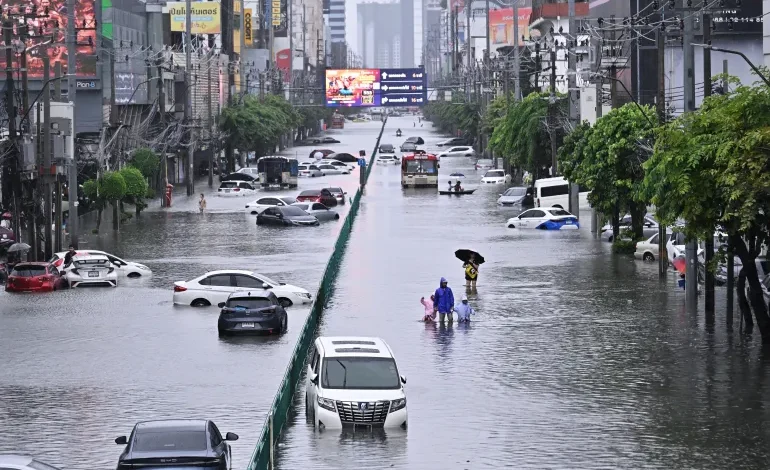
The reality on the ground has been harrowing. Across central and eastern Bangkok, scenes of urban paralysis unfolded with alarming speed. On arterial routes like Phetchaburi Road, commuters abandoned submerged vehicles, while others waded through waist-deep, murky water. The city’s famous vibrant street life was abruptly extinguished. Vendors who rely on daily foot traffic were forced to shutter their stalls, and panic buying emptied supermarket shelves as residents scrambled to stockpile drinking water and essential provisions in anticipation of prolonged isolation.
For the hundreds of thousands of residents living along the capital’s intricate network of khlongs (canals), the situation escalated from an inconvenience to an existential threat. Somkid Pheuk-ngam, a 67-year-old vendor residing near a canal just north of central Bangkok, described a relentless encroachment of water that trapped her inside her home. “The water keeps coming in. It’s hard to go out now. It’s like my waist level now,” she told reporters. “I cannot go anywhere. I have been closing my shop for two days now”. For long-time residents like Somkid, the scale of the disaster is deeply ominous, prompting comparisons to the city’s darkest chapters. “I think this time is worse than the 2011 flood,” she added, referencing a benchmark catastrophe that remains seared into the national consciousness.
The magnitude of the crisis prompted an immediate, multi-agency mobilization. The Royal Thai Army deployed emergency relief assets, sending high-clearance military trucks to transport stranded civilians and setting up field kitchens to distribute hot meals to those cut off from food supplies. Concurrently, the BMA rapidly converted public schools located on higher ground into temporary emergency shelters. District offices were instructed to actively identify and extract vulnerable residents, prioritizing the elderly and those with mobility issues.
At the center of this frantic coordination is Bangkok Governor Chadchart Sittipunt, who has utilized social media to deliver stark warnings and real-time updates to the city’s ten million residents. The governor’s messaging has been marked by a sobering transparency regarding the limits of the city’s infrastructure. “The rain keeps falling and we are doing our best. We are trying to pump the water out, but the water in canals are full,” Chadchart stated over the weekend. He explicitly warned that the current crisis “poses a risk to people’s lives” and urged extreme caution for those residing near the overflowing waterways.
Perhaps the most chilling of the governor’s directives was aimed at the city’s most medically vulnerable. Chadchart issued an urgent plea for families of bedridden patients reliant on life-saving, electricity-dependent medical equipment to evacuate them to hospitals immediately. With power outages rippling through flooded neighborhoods and emergency medical services struggling to navigate the submerged streets, remaining in a flooded home presents an acute, life-threatening risk for those on ventilators or dialysis machines.
While the city itself grinds to a halt, vital national infrastructure is straining to maintain connectivity. Suvarnabhumi Airport, Thailand’s primary international aviation hub, remained operational despite the surrounding deluge. However, authorities issued severe travel advisories, urging departing passengers to factor in an additional two to three hours of transit time just to navigate the flooded highways leading to the terminals. The sight of tourists dragging luggage through deep water to reach airport rail links underscored the indiscriminate nature of the crisis, impacting locals and international visitors alike.
The trauma of the current inundation is inextricably linked to Thailand’s fraught history with extreme weather. The spectre of 2011 hangs heavily over the current response. That year, a catastrophic monsoon season triggered widespread flooding across the country, killing more than 500 people, inundating vast industrial estates, and causing billions of dollars in economic damage. While the 2011 floods were largely characterized by massive volumes of water flowing down from the northern plains into the capital basin over several weeks, the 2026 event is a localized, high-intensity deluge—a “rain bomb” that overwhelmed the city’s internal defenses almost instantly.
Furthermore, the nation is still reeling from a devastating weather event less than a year prior. In November 2025, Thailand’s southern provinces were battered by what meteorologists described as “once-in-300-years” rainfall. That disaster claimed at least 145 lives and destroyed thousands of homes, exhausting national disaster relief budgets and fraying the psychological resilience of the population. The fact that an event of similar destructive intensity has now struck the capital so soon after the southern tragedy has ignited fierce public debate regarding the country’s preparedness for an era defined by climatic extremes.
The flooding in Bangkok is not merely an anomaly of weather; it is the predictable consequence of profound geographical and structural vulnerabilities intersecting with the accelerating impacts of climate change. Bangkok is a sinking megacity. Built on a swampy floodplain at the mouth of the Chao Phraya River, the city is steadily subsiding due to the historical over-extraction of groundwater and the sheer crushing weight of its sprawling, concrete urbanization. As sea levels in the Gulf of Thailand rise, the capital is being squeezed between the descending landmass and the ascending ocean.
Urban development has exacerbated the crisis. Over the past four decades, the rapid, often unchecked expansion of the city has paved over the natural floodplains and filled in the traditional canals that once earned Bangkok the moniker “Venice of the East.” These canals historically served as vital drainage arteries, absorbing and channeling excess monsoon rains away from populated areas. Today, the heavily concreted urban landscape offers no natural absorption, turning streets into raging rivers the moment the antiquated underground drainage pipes reach their capacity.
The municipal government has spent billions of baht over the years constructing giant underground drainage tunnels, reinforcing flood walls along the Chao Phraya, and installing massive water pumps. Yet, as the events of September 2026 demonstrate, engineering solutions have their limits when confronted with the sheer volume of water unleashed by intensifying, climate-driven storm systems. When 300 millimetres of rain falls within two days, the physical capacity of the infrastructure is simply overwhelmed, regardless of how many pumps are activated.
As the rain continues to fall and the army works through the night to ferry residents to safety, the immediate focus remains squarely on survival and stabilization. But as the waters eventually recede, leaving behind a thick layer of toxic silt and billions in property damage, Bangkok will be forced to confront a deeply uncomfortable reality. The declaration of all 50 districts as a disaster zone is not just a response to a passing storm; it is a glaring warning sign about the long-term viability of a global metropolis. Without radical transformations in urban planning, climate adaptation, and infrastructure investment, the paralyzing inundation of September 2026 may serve not as a rare catastrophe, but as a grim preview of the Thai capital’s future.