UK Recognition of Palestine One Year On: How Starmer’s Historic Move is Driving Real Policy

When British Prime Minister Keir Starmer stepped to the podium outside 10 Downing Street on September 21, 2025, to formally recognize the State of Palestine, the immediate reaction in international diplomatic circles was deeply polarized. To supporters of the Palestinian cause, it was a long-overdue validation of international law. To critics, particularly within the Israeli government, it was condemned as a dangerous reward for the terrorism that sparked the horrific conflict two years prior. Yet, amongst foreign policy analysts, a profound skepticism lingered: Was this merely a performative gesture designed to pacify a fractured Labour Party base, or did it represent a substantive pivot in British statecraft?
One year later, the answer has become unmistakably clear. The United Kingdom has spent the past twelve months meticulously transforming the rhetoric of recognition into the hard architecture of state-building. By moving beyond symbolic declarations, the British government is laying down a concrete policy framework designed to make a two-state solution operationally viable for the “day after” the guns finally fall silent.
The foundation for this shift was laid in July 2025, when Prime Minister Starmer issued a stark ultimatum. Facing an unprecedented humanitarian catastrophe, Starmer announced that the UK would unilaterally recognize a Palestinian state ahead of the United Nations General Assembly in September unless the Israeli government took “substantive steps” to end the appalling situation in Gaza, commit to a ceasefire, halt West Bank annexation, and re-engage with a long-term peace process. When that deadline passed without the demanded diplomatic shifts, Starmer executed the policy, declaring that the UK recognized Palestinian statehood over provisional borders based on the 1967 lines, with equal land swaps to be finalized in future negotiations.
The domestic political calculus behind the move was delicate but ultimately stable. Polling conducted in September 2025 showed that while the issue was highly emotive, a plurality of the British public backed the prime minister, with 44 percent in favor of recognition and only 18 percent opposed. This mandate allowed Downing Street to press forward with the institutionalization of the new state relationship.
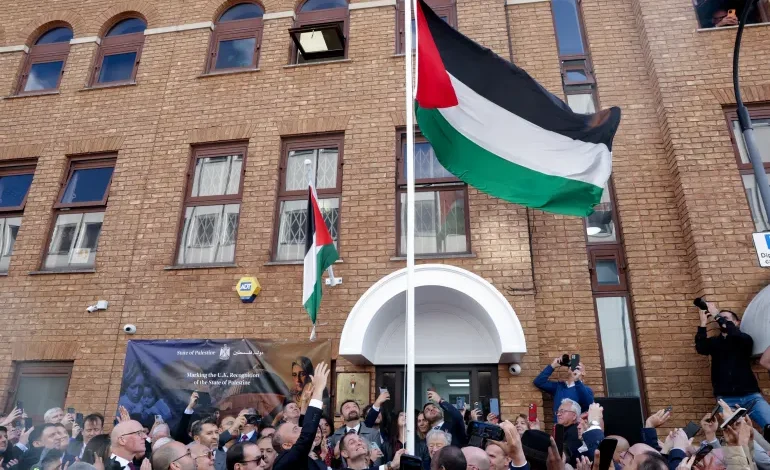
The most visible manifestation of this new era occurred on January 5, 2026, when the Embassy of the State of Palestine officially opened in London. The diplomatic upgrade from a “mission” to a full embassy was not merely a change in letterheads; it fundamentally altered how Ramallah interacts with Whitehall. Husam Zomlot, who had served as the Palestinian head of mission, was elevated to full ambassadorial status, declaring the embassy’s opening as proof that Palestinian identity “cannot be denied”.
This elevation has allowed for direct, state-to-state bilateral mechanisms that previously required third-party facilitation. The embassy now operates with the full diplomatic immunities and communication channels afforded to sovereign nations, streamlining trade discussions, educational exchanges, and most importantly, security and governance dialogues directly with the Foreign, Commonwealth and Development Office (FCDO).
However, the British government understood that diplomatic recognition without functional governance is a hollow victory. Recognizing the systemic weaknesses, corruption allegations, and logistical paralysis that have long plagued the Palestinian Authority (PA), Starmer’s government initiated a massive economic and institutional intervention. This effort is being spearheaded by Sir Michael Barber, who was appointed as the UK Envoy for Palestinian Authority Governance.
Barber, a veteran of Whitehall efficiency known for establishing Tony Blair’s famed “Delivery Unit,” was tasked with an incredibly complex mandate: to help reform the PA so that it is institutionally capable of governing both the West Bank and a post-conflict Gaza. Over the past year, Barber’s team has deployed intensive technical and financial support to overhaul the PA’s civil service, increase transparency in its financial mechanisms, and rebuild its delivery capabilities. The British strategy is clear: if the international community expects the PA to take control of Gaza and sideline Hamas, the PA must be transformed into a competent, corruption-free administrative body that can actually deliver basic services to the Palestinian people.
This state-building effort runs parallel to a stringent security and humanitarian track. In his recognition speech, Starmer was unequivocal that the two-state solution is the “exact opposite” of Hamas’s vision, explicitly stating that the militant group can have no role in the future governance or security of the territory. Over the past year, the UK has continually tightened sanctions against Hamas leadership, attempting to surgically isolate the terror organization while simultaneously elevating the PA.
Simultaneously, the UK has leaned into its domestic capabilities to address the immediate human toll of the conflict. In a highly emotional initiative championed by the Labour government, the UK began evacuating groups of sick and injured children from Gaza to be treated by the National Health Service (NHS). While this humanitarian airlift serves a relatively small number of patients compared to the overwhelming casualties on the ground, it has served as a powerful emblem of the UK’s commitment to preserving human life amidst the geopolitical deadlock.
The broader geopolitical shockwaves of the UK’s recognition continue to reverberate. Crucially, Britain did not step out onto this diplomatic ledge alone. The September 21, 2025, recognition was closely coordinated with Canada and Australia, creating a unified bloc of influential “middle powers”. This coordination was a strategic masterstroke, insulating the UK from isolated diplomatic blowback and signaling to both Washington and Jerusalem that the traditional Western consensus on waiting for a finalized peace treaty before granting recognition had fundamentally fractured.
The Israeli government, unsurprisingly, has maintained a fiercely hostile posture toward this middle-power consensus. Following the recognition, Israeli officials condemned the move as an action that “undermines the chances of achieving a peaceful solution”. Diplomatic relations between London and the government of Prime Minister Benjamin Netanyahu have remained decidedly frosty over the past twelve months, characterized by testy phone calls and public disagreements over the UK’s suspension of certain arms export licenses. Yet, the Starmer administration has held firm, arguing that preserving the viability of a two-state solution requires urgent, unilateral momentum when the bilateral peace process is entirely defunct.
As the one-year anniversary of the recognition passes, the Middle East remains entrenched in a profound and violent crisis. The UK’s recognition of Palestine did not magically end the bombardment, nor did it immediately secure the release of the remaining hostages. But what the past year of British foreign policy has achieved is the construction of a viable off-ramp.
By institutionalizing the Palestinian presence in London and aggressively funding the reform of the Palestinian Authority under Sir Michael Barber, the UK has built the administrative and diplomatic scaffolding required for a sovereign Palestine to actually function. The British government has proven that recognizing Palestinian statehood is not the end of the diplomatic process, but rather the rigorous, demanding beginning of building a sustainable peace.