AI and Green Finance Top the Agenda at Arab Finance Summit in Abu Dhabi

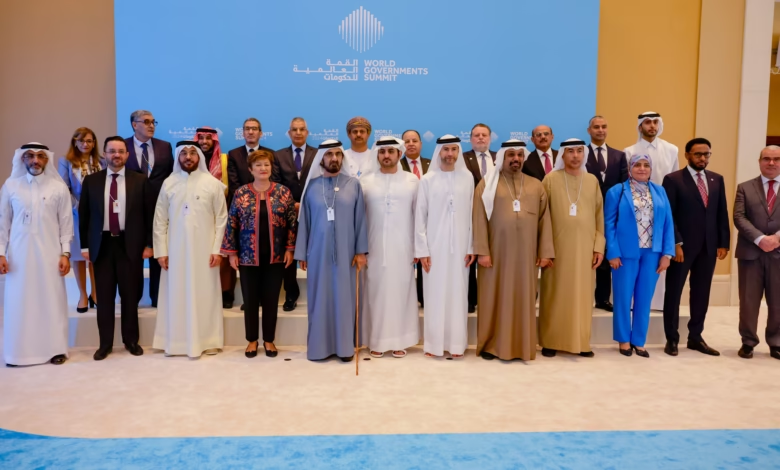
As the morning sun rises over the gleaming towers of the United Arab Emirates capital this Monday, the region’s elite economic policymakers, central bank governors, and finance ministers are gathering for a summit that will define the trajectory of Middle Eastern wealth for decades to come. Today marks the official commencement of the 17th Ordinary Session of the Council of Arab Finance Ministers, converging concurrently with the Golden Jubilee celebrations of the Arab Monetary Fund (AMF). While the 50th-anniversary banners fly high under the high patronage of UAE President His Highness Sheikh Mohamed bin Zayed Al Nahyan, the closed-door agenda reflects an acute, hyper-modern focus.
Fifty years ago, the AMF was established in an era defined by oil embargoes and the collapse of fixed exchange rates, tasked primarily with managing regional liquidity and stabilizing volatile currencies. Today, as the ministers take their seats in Abu Dhabi, the institution is confronting a vastly more complex, forward-looking mandate. The agenda formalized for this morning’s plenary sessions strips away historical nostalgia, replacing it with the urgent macroeconomic imperatives of the 21st century. The finance chiefs are not gathered to discuss traditional debt bailouts; they are here to architect a sovereign economic shield built on artificial intelligence, green infrastructure, and stringent global tax compliance.
The most anticipated briefing of the morning centers on a technological paradigm shift: the integration of Artificial Intelligence into fiscal policy and public finance management. For decades, the administrative machineries of many Arab states have been hindered by bureaucratic inefficiencies, fragmented data silos, and a reliance on reactive economic planning. In a region historically tethered to the extreme volatility of global energy markets, the inability to accurately predict and rapidly adapt to macroeconomic shocks has frequently resulted in severe fiscal deficits.
The AMF is utilizing today’s session to position AI not as a corporate buzzword, but as an absolute sovereign necessity. Ministers are reviewing comprehensive frameworks on how machine learning algorithms can fundamentally revolutionize the architecture of government finance. By leveraging big data, Arab finance ministries can transition to predictive macroeconomic forecasting, anticipating fluctuations in global commodity prices and consumer behavior with unprecedented precision. Furthermore, AI-driven policy tools are being evaluated for their capacity to optimize massive public expenditure networks, automate complex auditing processes, and detect financial anomalies and tax evasion in real-time. For nations striving to execute ambitious economic diversification agendas, the deployment of these technologies is viewed as the definitive catalyst for streamlining public sectors and fostering environments ripe for venture building and digital entrepreneurship.
Running parallel to the digital transformation is the equally urgent imperative of climate adaptation. A critical anchor of the 17th Ordinary Session is the high-level review of a World Bank Group policy paper titled “Sustainable Finance for Sustainable Infrastructure.” As the powerhouse economies of the Gulf and the emerging markets of the Levant and North Africa accelerate their industrial expansion, they are confronted with a stark geographic reality. The Arab region is disproportionately vulnerable to the accelerating impacts of climate change, facing acute water scarcity, rapid desertification, and rising extreme heat that threatens both public health and economic productivity.
The finance ministers are grappling with the immense capital mobilization required to fundamentally rewire the region’s physical environment. Transitioning to a climate-resilient future demands the construction of next-generation, energy-efficient desalination plants, vast transnational renewable energy grids, and technologically integrated green logistics corridors that can facilitate seamless continental trade. Financing this massive infrastructure pipeline requires trillions of dollars, a burden that cannot be shouldered by state treasuries alone.
Discussions in Abu Dhabi today are heavily centered on developing robust, domestic sustainable finance frameworks. The AMF and the assembled ministers are mapping out strategies to deepen regional green bond markets, incentivize private sector investment in sustainable projects, and align national spending with global climate goals. The objective is to ensure that the massive infrastructure mega-projects planned for the next decade are not only environmentally resilient but are also financially viable and attractive to the new wave of global ESG (Environmental, Social, and Governance) institutional investors.
Equally critical to the region’s long-term fiscal health is the evolving architecture of global taxation. The Arab financial landscape is undergoing a historic structural shift. For decades, several economies in the region successfully operated as low- or zero-corporate-tax environments, utilizing their tax-free status as a primary magnet for foreign direct investment and multinational corporate headquarters. However, as these nations have integrated more deeply into the sophisticated plumbing of the global financial system, they have had to pivot toward stringent international compliance to protect their economic sovereignty.
Reflecting this profound transition, today’s agenda features a dedicated presentation by the Organisation for Economic Co-operation and Development (OECD) on the latest developments concerning Base Erosion and Profit Shifting (BEPS) actions. The implementation of a global minimum corporate tax rate and the aggressive international push to close cross-border tax loopholes fundamentally alter the fiscal strategies of Arab nations. The United Arab Emirates, for instance, recently introduced a federal corporate tax, marking a watershed moment in its economic maturation.
By facilitating these high-level OECD briefings, the AMF is ensuring that its member states are not merely passive recipients of Western-designed economic regulations. Instead, Arab finance ministries are learning to actively shape their domestic tax policies to maintain their status as highly attractive hubs for global capital while simultaneously securing vital new streams of non-oil government revenue. Mastering this balance is essential for funding the very AI initiatives and green infrastructure projects dominating the rest of the summit’s agenda.
It is entirely fitting that these pivotal conversations are unfolding in Abu Dhabi, the permanent headquarters of the AMF since its founding. Under the leadership of President Sheikh Mohamed bin Zayed, the UAE has cemented its position as the indispensable anchor of Arab economic integration. The Emirates’ diplomatic neutrality, immense sovereign wealth, and relentless drive toward technological modernization provide the AMF with the stability and institutional backing necessary to execute its complex mandate. The UAE’s hosting of the Golden Jubilee reaffirms the nation’s strategic doctrine of prioritizing joint Arab action, serving as a vital platform where cross-border dialogue translates into actionable, unified policy.
As the morning sessions give way to the official Golden Jubilee celebrations—complete with documentary retrospectives honoring the pioneers of Arab banking and a special ceremony honoring five decades of structural contributions—the true significance of the day remains firmly rooted in the future. The Arab Monetary Fund has survived a half-century of regional conflicts, oil busts, and global financial panics by remaining fiercely adaptable. It has evolved from a lender of last resort into an intellectual heavyweight and a primary engine of institutional capacity building.
The roadmap being formalized today in Abu Dhabi ensures that the AMF’s next fifty years will be defined by proactive mastery rather than reactive crisis management. By embracing artificial intelligence to modernize state treasuries, committing institutional capital to sustainable green infrastructure, and rigorously aligning regional laws with complex global tax frameworks, the AMF is actively rewriting the rulebook for continental growth. The message emerging from the closed-door sessions in the UAE capital this morning is unmistakable: the Arab financial sector is preparing to meet the 21st century on its own terms, asserting a fierce, technologically advanced sovereignty over its economic destiny.