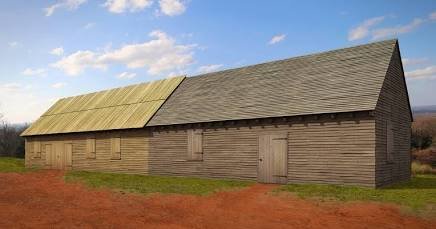
Monticello’s Child Labor: The Dark Reality of Thomas Jefferson’s Nailery

In the American historical imagination, Thomas Jefferson is almost exclusively portrayed as the ultimate agrarian philosopher. He is the gentleman architect who drafted the Declaration of Independence in a rented Philadelphia room, a visionary who spent his days designing neoclassical rotundas, studying botany, and imagining a republic of yeoman farmers. For over a century, the guided tours and history textbooks surrounding his Virginia estate, Monticello, meticulously cultivated this pastoral, intellectual myth.
But beneath the serene, manicured lawns of the mountaintop lay a vastly different, deeply uncomfortable reality. Monticello was not merely a tranquil farm; it was a highly organized, grueling industrial enterprise. And during the peak of its financial operation, the most lucrative engine of that enterprise was a commercial nail factory powered almost entirely by enslaved children.
To understand how the author of the American creed of liberty became the architect of a child labor camp, one must first look at the crushing financial pressures consuming the Founding Father. In 1794, Jefferson temporarily retired from public life, stepping down as George Washington’s Secretary of State, and returned to Monticello. He arrived to find his estate hemorrhaging money. Decades of lavish European spending, the relentless acquisition of fine art and books, and his obsessive, unending architectural renovations to the main house had left him deeply in debt to British and domestic creditors.
Compounding this financial crisis was an agricultural shift. For generations, tobacco had been the cash crop of the Virginia planter class, but it aggressively depleted the soil. Jefferson was forced to transition his fields from tobacco to wheat. Wheat cultivation, while better for the land, required far less year-round labor than tobacco. This agricultural pivot created what Jefferson coldly viewed as a “surplus” of young enslaved laborers. Never one to let a potential asset sit idle, Jefferson desperately needed a reliable cash enterprise that did not depend on the unpredictable Virginia weather or the depleted soil.
He found his solution in early America’s booming construction market. As towns and cities rapidly expanded along the Eastern Seaboard in the post-Revolutionary era, the demand for iron nails was insatiable. By establishing a commercial nailery, Jefferson transformed the main artery of his plantation—a bustling industrial avenue known as Mulberry Row—into a highly profitable manufacturing hub.
Mulberry Row and the Sensory Divide
Located just a few hundred yards south of his elegant mansion, Mulberry Row was the sensory opposite of Jefferson’s quiet, glass-paned study. It was a loud, smoky, and crowded thoroughfare consisting of storehouses, smokehouses, a joiner’s shop, and the intense, radiating heat of the iron forge.
The most disturbing aspect of the Monticello nailery was its workforce. Jefferson realized that the sheer physical strength required to forge nails did not necessitate adult men, whom he deemed more “valuable” for heavy agricultural labor like plowing and harvesting. Instead, he conscripted enslaved boys ranging in age from ten to sixteen.
Jefferson approached the management of these children not as a reluctant participant in the institution of slavery, but with the cold, calculating precision of an Enlightenment scientist. He viewed the boys as units of production and instituted a ruthless, micromanaged quota system to maximize their efficiency. Every morning at dawn, the boys were handed a specific weight of raw iron rods, imported from Philadelphia or Richmond. They stood before blazing forges, heating the iron red-hot, and hammering it into thousands of nails over the course of a twelve-to-fourteen-hour workday. At dusk, the finished nails were weighed against the raw material they had been given that morning.
If a boy’s finished output did not mathematically align with the raw iron—accounting for a small, meticulously calculated margin of acceptable waste—he was severely punished. Jefferson personally tracked the daily output of these children in his Farm Book ledgers, calculating their efficiency down to the fraction of an ounce. He recorded the names of boys like Burwell, Wormley, Brown, and Cary, treating their daily exhaustion as mere data points in a ledger of profit and loss.
To maximize production, Jefferson utilized a deeply manipulative system of rewards. He occasionally distributed extra food, slightly better clothing, or a few pennies to the boys who consistently exceeded their daily quotas. This engineered competition deliberately pitted enslaved children against one another, masking a system of absolute, violent coercion behind the illusion of a meritocracy.
Generate Video OverviewThis may take a few mins
Key insight: A skilled enslaved boy at Monticello was expected to produce up to 10,000 nails a day. Working rapidly with heavy tools near open flames led to frequent burns, muscle fatigue, and long-term physical trauma for the developing children.
The Whip and the Myth of the Benevolent Master
For generations, apologists for Jefferson perpetuated the myth of the “benevolent master,” arguing that Monticello was an exception to the savage violence of the Deep South, a place where enslaved people were treated with paternalistic care. The reality of the nailery shatters this narrative entirely. When psychological manipulation and small rewards failed to extract the maximum possible profit from the enslaved boys, the overseers resorted to the whip.
The violence was not an aberration; it was an institutionalized feature of the factory’s success. The most notorious of Jefferson’s overseers was a man named Gabriel Lilly, who managed the nailery in the early 1800s. Lilly was renowned across the plantation for his brutality, routinely whipping the children to maintain a frenetic pace of production. In one documented instance, an enslaved boy named Cary became sick and fell behind on his quota. A fellow enslaved worker later recounted that Lilly whipped the boy so severely for his inefficiency that Cary was left physically broken.
Jefferson was fully aware of this violence. While he preferred to distance himself from the physical act of whipping—maintaining his self-image as a refined, enlightened philosopher—his own correspondence reveals his absolute complicity. In 1801, Jefferson wrote to an associate expressing immense satisfaction with Gabriel Lilly’s management. He noted that the nailery was thriving precisely because the overseer tolerated zero inefficiencies. The author of the Declaration of Independence actively subsidized his lifestyle, his wine collection, and his political campaigns through the systematic terrorization of children.
The Textile Workshop and the Exploitation of Girls
The industrial exploitation of youth at Monticello was not limited to the boys sweating in the forge. While the young males were sent to the nailery, enslaved girls of the exact same age—ranging from ten to sixteen—were assigned to the textile workshops situated further down Mulberry Row.
Here, the girls were forced to spin cotton, flax, and hemp, and weave the coarse, scratchy “osnaburg” cloth that was used to clothe the entire enslaved population on the estate. Like the nailery, the textile operation was driven by Jefferson’s relentless desire for self-sufficiency and the reduction of his crippling debt. By forcing enslaved girls to manufacture the clothing for the rest of his human property, Jefferson eliminated the need to purchase imported British or northern textiles, keeping his overhead costs artificially low.
The conditions in the spinning rooms were suffocating and hazardous. The air was constantly thick with airborne fibers and dust, leading to chronic respiratory issues for the young workers. Just like their male counterparts in the forge, the girls were subjected to the same rigid, ledger-tracked quotas. Their daily output of spun thread and woven yards was measured and recorded, and failure to meet the mathematical expectations of the overseer was met with swift, physical punishment.
The Tragic “Graduation” to the Fields
The tragedy of the nailery and the textile workshops was compounded by their role within the broader lifecycle of the plantation. These industrial hubs were not pathways to specialized independence; they were essentially training grounds for lifelong compliance and endurance.
When an enslaved boy reached the age of sixteen, he “aged out” of the nailery. His body was deemed mature and strong enough for adult labor, and he was abruptly transferred from the forge to the sprawling agricultural fields to harvest wheat, tobacco, or hemp. The transition was devastating. After spending their formative childhood years mastering a highly specialized manufacturing trade—a trade that would have guaranteed a white apprentice a comfortable, middle-class livelihood—these teenagers were stripped of their positions and plunged into the grueling, sun-baked misery of the agricultural harvest.
Worse still, reaching adulthood made these young men and women more valuable as liquid financial assets. If Jefferson’s debts flared up, if a creditor demanded immediate payment, or if he needed to raise cash quickly for a new architectural project, the boys who had spent their childhoods generating his nail profits could be sold. They were routinely placed on the auction block, permanently separated from their parents, siblings, and the only community they had ever known on Mulberry Row, and sent deeper into the brutal frontiers of the American South.
Ultimately, the meticulous ledgers that Thomas Jefferson kept to track the output of the nailery serve as the most damning historical indictment of his legacy. For decades, historians viewed these Farm Books as evidence of his scientific genius. Today, they are rightly read as a meticulously documented confession. The ledgers prove that his reliance on slavery was not a passive, inherited societal flaw, but an active, hyper-calculated commercial strategy. He knew exactly how much raw iron a ten-year-old boy could hammer into nails in a fourteen-hour shift, and he knew exactly how much financial profit that child’s sweat would yield. Monticello was undeniably built on the genius of its architecture and the beauty of its gardens, but its foundations were paid for by the stolen childhoods of the forge.