New DNA Evidence Settles the Centuries‑Old Thomas Jefferson Paternity Question

For more than two centuries, it has been the most contentious, whispered, and heavily litigated paternity mystery in American history. Did Thomas Jefferson, the third President of the United States and the principal architect of the Declaration of Independence, father children with Sally Hemings, a woman enslaved at his Monticello plantation? The rumors, first published by a vengeful political journalist named James Callender in 1802, haunted Jefferson’s legacy, pitting oral histories passed down by Black descendants against the fierce, institutionalized denials of white biographers and heritage societies.
Today, that debate is permanently closed. Following a painstaking, 15-year scientific investigation led by Smithsonian scholar Richard Kurin, geneticists have achieved what was long thought impossible: they have successfully mapped Thomas Jefferson’s genome directly from a lock of his hair. The resulting genetic analysis, set for publication in the peer-reviewed journal PNAS (Proceedings of the National Academy of Sciences), provides incontrovertible proof that Jefferson fathered the children of Sally Hemings, laying to rest 224 years of historical revisionism.
The scientific achievement at the heart of this revelation is as profound as its historical implications. For decades, geneticists were stymied by a fundamental biological hurdle: hair clipped from a human head typically lacks the follicular root, which contains the nuclear DNA required for comprehensive genomic sequencing. Kurin and his team, however, developed an innovative technique to recover trace DNA from multiple rootless hair samples held in a museum collection.
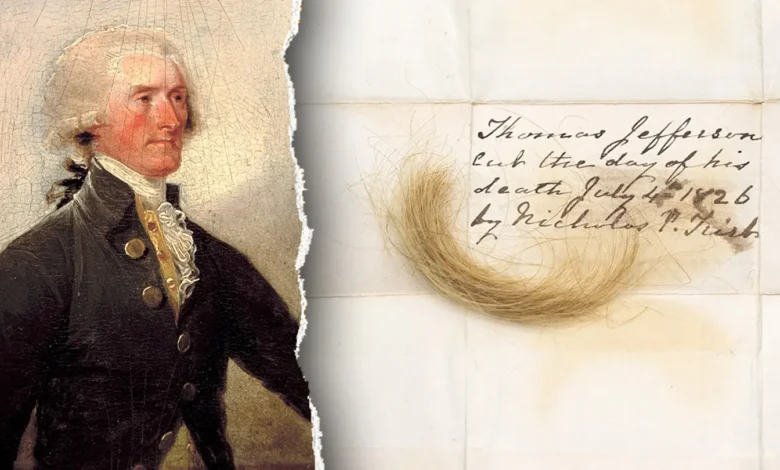
The provenance of the central sample was meticulously documented; a note buried deep in the Monticello archives confirmed that the lock of hair was clipped from Jefferson’s head on July 4, 1826, the day he died. By analyzing the mitochondrial genomes and cross-referencing the samples’ identity to one another, scientists verified they were dealing with the authentic genetic code of the Founding Father.
Once the genome was sequenced, the researchers compared it directly against the DNA of the living descendants of Sally Hemings. To ensure absolute statistical certainty, the team ran 20,000 simulations of various paternity scenarios. The results were staggering. The odds of Jefferson not being the father of Madison and Eston Hemings were calculated to be less than one in 1,000. The data yields a 99.9 percent certainty of his paternity.
“The DNA speaks for itself,” Kurin remarked following the discovery, which is chronicled in his newly released book, History by a Hair. “We know that there are descendants of Madison Hemings and Eston Hemings that have a whole lot of Thomas Jefferson DNA”.
This direct genomic match is critical because it definitively closes what historians have long referred to as the “Randolph Loophole.” In 1998, a landmark study published in the journal Nature first established a genetic link between the Jefferson line and the Hemings descendants. However, because Thomas Jefferson had no surviving legitimate male heirs, that study relied on the Y-chromosome of descendants of his uncle, Field Jefferson. While the 1998 study proved that a male in the Jefferson family fathered Eston Hemings, it left a sliver of ambiguity.
For the next 28 years, a vocal contingent of skeptics, including members of the Thomas Jefferson Heritage Society, weaponized that ambiguity. They argued vehemently that the Founding Father’s character made such a relationship “inconceivable,” pointing the finger instead at Jefferson’s younger brother, Randolph, or one of Randolph’s sons, who were known to visit Monticello. By extracting the DNA directly from Thomas Jefferson himself, Kurin’s team has effectively eradicated the last refuge of denial. The simulations specifically accounted for Randolph and his sons, statistically eliminating them as the fathers.
The scientific triumph, however, immediately forces a renewed moral reckoning with the paradox of Thomas Jefferson. How could a man whose pen birthed the phrase “All men are created equal” preside over a plantation where he kept his own children in human bondage?
The reality of the power dynamics at Monticello is deeply uncomfortable, stripping away the sanitized veneer of early American mythology. Sally Hemings was not merely an enslaved woman on the estate; she was the biracial half-sister of Jefferson’s late wife, Martha Wayles Jefferson. The relationship between Jefferson and Hemings is believed to have begun in Paris when Jefferson was in his mid-40s serving as the American minister to France, and Hemings was a 14-year-old girl brought along to chaperone his daughter.
Throughout his life, Jefferson was a prolific, almost obsessive record-keeper. He documented the weather, his crops, the exact number of nails forged in his nailery, and the daily operations of Monticello. Yet, in all of his voluminous extant writings, he never once acknowledged the paternity of Hemings’s offspring, nor did he ever explicitly confirm his entanglement with her. It was a masterpiece of historical omission, an architecture of silence designed to protect his political viability and his legacy from the social mores of 18th and 19th-century Virginia.
But biology, unlike archives, cannot be curated or redacted. The DNA serves as an incorruptible ledger.
The lives of the Hemings children reflect the agonizing complexity of their origins. According to historical records, Jefferson allowed two of their children, Beverly (a boy) and Harriet, to effectively “run away” from Monticello in 1822. They traveled to Washington, D.C., where their light skin allowed them to pass as white, blending into society and leaving behind descendants who were utterly unaware of their enslaved ancestry. Jefferson eventually freed his two younger sons by Hemings, Madison and Eston, in his will, though he never legally emancipated Sally Hemings herself. She lived her final years in Charlottesville, “given her time” by Jefferson’s legitimate daughter, Martha.
For generations, the oral histories of the Hemings family, particularly those passed down through the line of Madison Hemings, who gave a newspaper interview in 1873 asserting his parentage, were dismissed by mainstream white historians as hearsay or opportunistic fabrication. The new genomic data is a monumental validation of Black oral tradition. It proves that the enslaved communities possessed a truth that the highest offices of American power sought to bury.
The researchers emphasize that this discovery is not meant to merely indict a Founding Father, but to synthesize a fractured historical narrative. “The findings may enable descendants of ‘founding father’ Thomas Jefferson, whether born to Martha Wayles Jefferson or to Sally Hemings, and whether their ancestral legacy is one of slavery or freedom, to consider themselves as part of one and the same, complicated, American family,” the study authors wrote.
Indeed, the locking of the genetic code forces the United States to look at Monticello not just as a monument to democratic ideals, but as the birthplace of a deeply intertwined, biracial nation. For over two centuries, a lock of hair sat quietly in a museum archive, holding a secret that the author of the Declaration of Independence thought he had taken to the grave. Today, that hair has rewritten American history, proving that no amount of prestige, power, or omission can permanently erase the truth.