How Archaeology and Archives Exposed Thomas Jefferson’s Nailery

History is rarely rewritten by a single, explosive revelation. More often, the dismantling of a deeply entrenched national myth requires a slow, methodical convergence of disciplines. For over a century, the myth of Thomas Jefferson’s Monticello was impenetrable. The third President of the United States was revered globally as the ultimate philosopher-statesman, a benevolent intellect who penned the Declaration of Independence and reluctantly participated in the institution of slavery only because he was bound by the legal and economic realities of his era.
This pastoral, sanitized narrative survived for generations precisely because it was institutionally protected. The physical remnants of slavery at Monticello had been systematically erased from the landscape, leaving only the elegant neoclassical mansion and pristine gardens. To fracture this mythology, modern historians could not simply rely on traditional archival reading; the archives were written by the enslaver himself. Uncovering the agonizing reality of life on the plantation required a revolutionary, cross-disciplinary synthesis. It demanded that researchers decode the cold mathematics of Jefferson’s private journals, physically tear into the manicured turf of the mountaintop, and elevate centuries-old Black oral traditions to the level of academic gospel. The result of this monumental effort fundamentally transformed our understanding of the American founding.
The Cryptography of Cruelty: Decoding the “Farm Book”
The first pillar of this historical reconstruction began in the quiet reading rooms of institutional archives. Thomas Jefferson was the quintessential product of the Enlightenment. He was a man obsessed with categorization, measurement, and supreme operational efficiency. He documented nearly every detail of his sprawling life, from daily barometric pressure readings to the exact seasonal yields of his experimental pea crops. However, this same clinical, scientific detachment was applied with devastating precision to the management of his human property.
For modern historians researching the enslaved community, the most damning and revealing documents were Jefferson’s overarching Farm Book and a highly specific, localized volume known as the Nailery Account Book, which covers the peak industrial production years from 1796 to 1800. For over a century, early biographers and historians viewed these ledgers through a lens of profound historical bias. They read the columns of numbers and interpreted them merely as evidence of Jefferson’s scientific mind, his agrarian innovation, and his meticulous approach to plantation management.
It took a new generation of critical historians in the late twentieth century to break the code of these ledgers and recognize what the numbers actually represented: a highly calibrated, violently enforced system of child labor.
The ledgers contained long columns of first names, Brown, Wormley, Burwell, Cary, Shepherd, written alongside highly specific mathematical weights. When historians stopped looking at these documents as benign agricultural records and started viewing them as industrial production logs, they realized they were looking at a rigid quota system. By cross-referencing the first names in the Nailery Account Book with Jefferson’s overarching Farm Book—which tracked the births, familial units, and ages of every enslaved person on the property—researchers confirmed a horrifying demographic reality. The workers operating the heavy hammers in the forge were not adult men; they were enslaved boys, primarily ranging in age from ten to sixteen.
The ledgers revealed the brutal, daily math of the operation. Jefferson recorded exactly how many pounds of raw iron nail rod were distributed to each boy at the crack of dawn. He then recorded exactly how many pounds of finished nails were returned by that same child at dusk. Jefferson was keenly aware that the forging process naturally produced some waste as iron was heated, cut, and hammered. To account for this, he calculated a metric he coldly labeled the “toleration of loss” an acceptable margin of wasted iron.
By utilizing this formula, historians could see precisely how Jefferson identified inefficiencies on the factory floor. If a boy returned a yield of nails that fell below the toleration of loss, it meant he was either working too slowly, wasting raw material, or failing to meet his strict daily quota. These mathematical inefficiencies were inevitably corrected by the overseer’s whip. The ink on the page definitively proved that the violence at Monticello was not random, nor was it the rogue action of a sadistic overseer operating outside the master’s knowledge. It was a highly calculated, ledger-driven corporate strategy designed, monitored, and optimized by Jefferson himself to maximize the extraction of wealth from children.
Breaking the Earth: Excavating Mulberry Row
Paper records, however, only tell the perspective of the man holding the pen. Archival ledgers can calculate the financial output of a child, but they cannot capture the sensory terror of the forge, the heat of the fire, or the physical toll of the labor. Furthermore, institutional skeptics frequently argued that ledgers were just theoretical plans, not necessarily reflective of the physical reality on the ground. To truly understand the lived experience of the enslaved boys working the nailery, researchers had to abandon the archives and look to the ground.
In the 1980s and 1990s, under the pioneering direction of landscape archaeologist Dr. William Kelso, and later continued by Fraser Neiman, Monticello launched an aggressive archaeological reassessment of Mulberry Row. This marked a profound shift in the philosophy of historical archaeology in the United States. Instead of merely digging for the fine imported china and wine bottles of the elite planter class, archaeologists began actively searching for the erased footprints of the enslaved community’s dwellings and industrial workshops. Mulberry Row was the plantation’s industrial hub, the loud, smoky artery that sustained the estate, but it had been entirely erased from the visual landscape.
Locating the exact site of the nailery required a brilliant combination of archival mapping and sheer, back-breaking manual labor. The archaeologists were guided by a crucial historical document: a 1796 insurance plat drawn by Jefferson himself for the Mutual Assurance Society of Virginia. This hand-drawn map outlined the various wooden outbuildings along Mulberry Row, providing a rough spatial blueprint. Utilizing this plat, Kelso, Neiman, and their teams began laying out precise excavation grids along the southern edge of the mountaintop, carefully slicing through the manicured turf that had hidden the truth for over a century.
Beneath the modern grass, they hit the industrial strata. Digging through the layers of time, they unearthed a massive deposit of coal ash, charcoal, and heavily oxidized iron slag. This dark, scorched layer of earth was the unmistakable physical signature of an intensive eighteenth-century blacksmithing operation. By painstakingly mapping the concentration of this industrial waste, archaeologists were able to recover the exact architectural footprint of a building measuring roughly eighteen by thirty-seven feet. After two centuries of erasure, they had finally found the lost nail factory.
The Iron Confession: Matching Artifacts to the Math
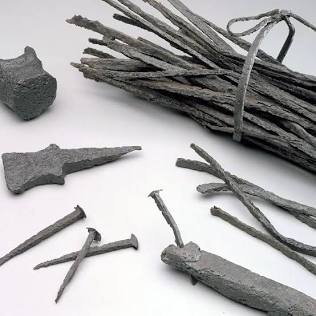
What the archaeological teams found inside that eighteen-by-thirty-seven-foot footprint brought the cold math of Jefferson’s ledgers into sharp, devastating physical reality. Archaeologists excavated thousands of artifacts from the site, sifting through the dense Virginia clay to recover the remnants of the operation. While they found ironworking tools and architectural hardware, the most vital artifacts were the nails themselves.
The dirt was littered with thousands of dropped, discarded, and malformed wrought-iron nails. By rigorously analyzing the physical characteristics of these iron fragments, archaeologists could map the specific workflow of the factory floor. The artifacts matched the written records perfectly, creating a flawless synthesis of dirt and data. The varying sizes of the excavated nails corresponded exactly to the distinct classifications, known as “penny sizes” (such as 6-penny or 10-penny nails), that Jefferson had meticulously noted in his account book. The physical evidence proved the staggering scale of the operation detailed in the archives; the boys were producing thousands of nails a day, fueling early America’s construction boom.
More poignantly, the malformed nails found buried in the dirt told a story that the neat columns of the ledgers explicitly left out: the story of exhausted, frightened children. The twisted, half-finished iron points, the off-center heads, and the cracked shafts were the physical evidence of young boys struggling to manage heavy iron hammers and blazing heat at the end of a grueling fourteen-hour shift.
Forging a nail by hand requires rhythmic, precise strikes. When a twelve-year-old boy’s arms gave out from sheer muscle fatigue, his hammer strike missed, ruining the nail. Fearing the overseer’s whip for failing to meet the strict “toleration of loss” quota, the boys frequently dropped their mistakes into the dirt floor of the forge, attempting to hide their inefficiencies. There, the twisted iron lay buried for two centuries. Each bent nail pulled from the earth by the archaeologists was a frozen moment of a child’s exhaustion and fear, preserved in iron, providing the physical proof of exploitation that the ledgers only hinted at.
The Living Archive: The “Getting Word” Synthesis
The final, and perhaps most crucial, step in reconstructing the Monticello nailery was moving beyond the archival ledgers and the excavated slag, and returning humanity to the enslaved boys who suffered there. Data and artifacts can prove the mechanics of exploitation, but they cannot restore a stolen identity. To rely solely on the archives and the dirt was to continue defining these individuals strictly through the lens of their enslavement.
To move beyond the cold statistics of Jefferson’s ledgers, historians launched the Getting Word African American Oral History Project in 1993. Initiated by historians Lucia Stanton and Dianne Swann-Wright, the project recognized that the true history of Monticello existed not just in the ground, but in the living memories of Black families. Because enslaved people were legally barred from reading and writing, their histories were preserved in the spoken word, passed down from generation to generation around kitchen tables across the country.
By tracking down and interviewing the living descendants of the enslaved families at Monticello, researchers were able to connect the boys in the nailery ledgers to real, resilient family networks. Through oral history and genealogical mapping, the boys on the spreadsheet were given back their surnames. The records showed a boy named Wormley working the forge; Getting Word connected him to the Hughes family, revealing Wormley Hughes as a man who survived the nailery to become Monticello’s head gardener. Another boy, listed simply as Burwell, was identified as Burwell Colbert, who would eventually become Jefferson’s most trusted personal attendant and a patriarch of his own sprawling family line.
The boys in the forge were no longer just anonymous units of production on Thomas Jefferson’s balance sheet. They were sons, brothers, and the foundational figures of families that survived the horrors of Virginia slavery to build lives in freedom.
By synthesizing archival decoding, meticulous dirt archaeology, and generational Black oral history, modern researchers achieved something truly remarkable. They did not just locate the physical foundations of a lost building; they completely dismantled a sanitized national myth. The unearthing of the nailery stripped away the protective veneer of the “benevolent master,” proving that the reality of the American founding is infinitely more complex and painful than the history books previously allowed. The comprehensive reconstruction of Mulberry Row stands as a testament to the fact that the true history of Monticello—and by extension, the United States itself is written just as much in the twisted iron slag and living oral traditions of enslaved families as it is in the soaring, immortal ink of the Declaration of Independence.