How Emirati Female Artists are Reshaping UAE’s Cultural Landscape

ABU DHABI — Step into the sunlit central atrium of a contemporary gallery district in the UAE, and the first thing that strikes you is not the sound of the city, but its weight. Suspended from the double-height ceiling hangs a massive, undulating sculpture: yards of heavy cotton rope tightly braided with human hair, passing through dense, raw blocks of cast concrete. A few paces away, a series of large-scale, hyper-saturated photographs depict gilded mirrors, synthetic leopard prints, and velvet curtains in a quiet domestic living room, where the faces of the occupants are hidden behind reflective glass and floral shadows. In an adjacent room, raw earth pigments mixed with indigo and saffron bleed into unprimed linen, capturing the faded archways of a 1970s residential neighborhood in Abu Dhabi.
This is not merely an art exhibition. It is a sophisticated, intergenerational project of spatial archaeology.
As the United Arab Emirates commemorates Emirati Women’s Day 2026 under the national theme unveiled by Her Highness Sheikha Fatima bint Mubarak—“We Emerge Stronger and Better”—and aligns with the overarching national mandates of the Year of Family and Year of Community, the nation’s cultural identity is undergoing a profound intellectual audit.
THE FEMALE ARTISTIC ARCHITECTURE OF SPATIAL MEMORY
- Historical Anchors (1980s–2000s):
- Dr. Najat Makki: Luminous Formalism & Color Fields
- Ebtisam Abdulaziz: Systems & Algorithmic Logic
- Dr. Karima Al Shomely: Semiotics of the Burqa
- Alia Zaal: Optics & Native Flora
- Contemporary Interdisciplinary (2010s–Present):
- Farah Al Qasimi: Consumer Camouflage & Domestic Interiors
- Afra Al Dhaheri: Materiality, Concrete & Hair
- Maitha Abdalla: Folklore & Subconscious Myths
- Almaha Jaralla: Vernacular Architecture & Textiles
- Rawdha Al Ketbi: Ruins & Accelerated Decay
- Sara Ahli: Glassmaking, Body & Physical Strain
For decades, external observers viewed the physical growth of the United Arab Emirates through a single, narrow lens: the hyper-accelerated transformation of desert dunes into a gleaming, skyscraper-filled metropolis. Yet urban space is never just steel, glass, and asphalt. Space is a living vessel of human memory, body language, domestic ritual, and social history.
At the very center of documenting, questioning, and preserving this shifting landscape stand female Emirati artists. Moving far beyond decorative aesthetics or superficial folklore, these women act as the primary architects of spatial memory.
Through painting, performance, chemical photography, glassblowing, and raw sculptural labor, they have built a critical visual framework. They record what the bulldozer replaces, capture how domestic life adapts to rapid modernization, and ensure that as the nation hurtles toward the future, its spiritual and material geography remains unbroken.
THE FOUNDATIONAL PIONEERS — LIGHT, GEOMETRY, AND SEMIOTICS
To understand the intellectual depth of contemporary Emirati art today, one must trace its roots back to the pioneering female artists who challenged convention in the late 20th century. Working long before the arrival of international art fairs, mega-museums, or commercial galleries, these early practitioners established visual arts as a serious domain for philosophical inquiry.
PIONEERING PARADIGMS OF GULF MODERNISM
- Dr. Najat Makki: Luminous Formalism, Fluorescent Pigments, Lunar Geometry, and Material Reliefs.
- Ebtisam Abdulaziz: Systems Performance, Algorithmic Logic, and Institutional Capital Critique.
- Dr. Karima Al Shomely: Deconstruction of Heritage Semiotics, Architectural Analysis of the Burqa.
1. Dr. Najat Makki: The Luminous Formalist
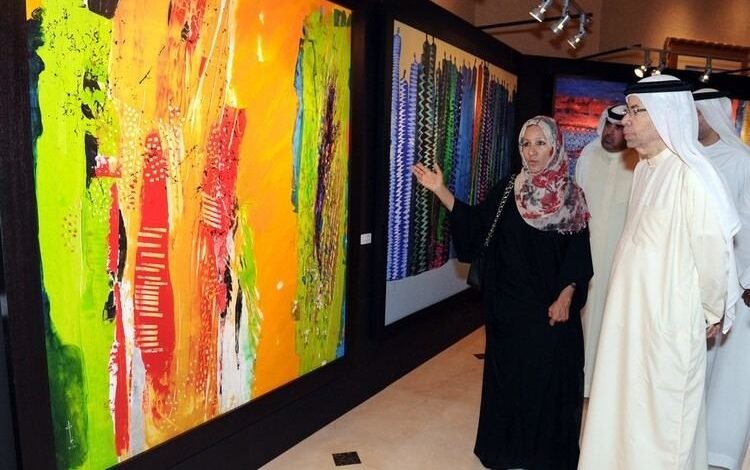
Dr. Najat Makki (b. 1956, Dubai) stands as the undisputed matriarch of Emirati visual modernism. As the first Emirati woman to earn a doctorate in the philosophy of art—graduating from Cairo’s prestigious College of Fine Arts in 2001—Makki introduced a rigorous academic and material foundation to Gulf art.
Makki’s practice revolutionized how artists engage with pigment and surface. In the late 1980s, while designing scenography for educational programming at the Ministry of Education, she began experimenting with fluorescent and ultraviolet paints. This culminated in her historic 1987 exhibition at Dubai’s Al Wasl Club, where she bathed her painted canvases in blacklight (UV-A), transforming two-dimensional painted planes into glowing, three-dimensional spatial environments.
Makki’s intellectual vocabulary orbits several key pillars:
- The Metaphysics of the Circle: Inspired by childhood observations of lunar cycles over the Persian Gulf, Makki treats the circle as an infinite, non-linear architecture of collective human memory.
- Material Integration: She mixes traditional oils with regional natural substrates—saffron, henna, indigo, and crushed minerals—alongside metal reliefs and woven textiles, bridging ancient Gulf trade routes with mid-century global abstraction.
- Topographical Rhythms: Her sweeping, fluid brushstrokes evoke both the physical contours of sand dunes and the flowing silhouettes of traditional women’s garments.
By insisting that color and light carry spiritual and spatial weight, Dr. Najat Makki created a pathway for generations of artists to treat the Emirati landscape not as a static backdrop, but as a living, glowing force.
2. Ebtisam Abdulaziz: Systemic Logic and Performance
Where Makki explored the luminous spirituality of form, Ebtisam Abdulaziz (b. 1975, Sharjah) introduced the sharp, uncompromising logic of conceptual performance and mathematics. Holding a dual degree in mathematics and science from Al Ain University, Abdulaziz utilizes numbers, grid structures, and algorithmic systems to dissect power dynamics and urban life.
In her landmark performance and photographic series Systemic Structures—presented at the inaugural UAE Pavilion at the 53rd Venice Biennale in 2009—Abdulaziz donned a tight black jumpsuit covered in glowing green numeric codes. She then walked through bank vaults, commercial centers, stock exchanges, and public streets across the UAE.
Ebtisam Abdulaziz’s Systemic Framework:
Human Body / Identity ➔ Wrapped in Algorithmic Code ➔ Inserted into Financial/Urban Spaces ➔ Reveals Economic Reduction
Her body operated as a living data vector. By inserting a human form covered in equations into financial districts, Abdulaziz created a searing visual critique of how hyper-capitalism and rapid urbanization reduce human identity, domestic life, and personal memory into quantifiable data points and real estate listings.
3. Dr. Karima Al Shomely: Deconstructing Heritage Semiotics
The intellectual deconstruction of heritage symbols finds its most rigorous advocate in Dr. Karima Al Shomely (b. 1965, Sharjah). Holding a PhD in Fine Arts from Kingston University London and serving as an Assistant Professor at the University of Sharjah, Al Shomely has dedicated her career to analyzing the material culture of the Gulf—most notably the Emirati Burqa (the traditional metallic-fabric face mask worn by elder women).
Moving far beyond Orientalist clichés that view the garment purely through the lens of oppression or exoticism, Al Shomely analyzes the Burqa as a sophisticated architectural object. Through fine art printmaking, archival photography, and bronze casting, she isolates its precise geometric lines, wooden support struts, and metallic cloth textures.
By enlarging these elements into abstract sculptures, Al Shomely demonstrates that the Burqa was an ingenious tool of environmental protection, personal privacy, and female identity. Her work transforms an item of personal attire into a monument of spatial memory, honoring the women who navigated the harsh climate of the pre-oil era.
THE HYPERREAL AND THE MATERIAL BODY — URBAN DOMESTICITY
As the United Arab Emirates accelerated into the 21st century, a new generation of female artists emerged. Raised amidst hyper-modern infrastructure, global digital networks, and consumer culture, these artists turned their attention to the immediate, physical realities of daily life: the domestic interior, the consumer mall, and the strain placed upon the human body by rapid urban growth.
MATERIAL & SPATIAL INQUIRIES OF THE NEXT GENERATION
- Farah Al Qasimi: Hyper-saturated photography, staged domesticity, and consumer camouflage.
- Afra Al Dhaheri: Heavy sculptural labor, braided rope, raw concrete, and hair as an organic clock.
- Sara Ahli: Blown glass, physical body strain, visceral organic folds, and material memory.
1. Farah Al Qasimi: The Hyperreal Vernacular
Farah Al Qasimi (b. 1991, Abu Dhabi), trained at the Yale School of Art and recognized as a 2025 Guggenheim Fellow, has become one of the most prominent international voices analyzing Gulf consumer culture. Her saturated, staged photographs and films offer an intimate look at the visual noise of modern life.
Al Qasimi’s lens captures the vivid, highly specific textures of Gulf domesticity:
- Synthetic Interiors: Synthetic leopard-print blankets, heavily gilded mirrors, velvet drapery, and plastic-wrapped salon chairs.
- The Strategy of Camouflage: She frequently obscures human faces using domestic textiles, shadows, or reflective surfaces, forcing the viewer to look at the surrounding environment rather than consuming the subject’s gaze.
- Commercial Hyperreality: Documenting arcade centers, shopping malls, and beauty parlors, examining how global consumerism mixes with local ideas of luxury, privacy, and taste.
In major public projects like Back and Forth Disco (New York) and exhibitions across global institutions, Al Qasimi shows that domestic spaces are not quiet retreats from the world, but active arenas where cultural identity, gender roles, and post-colonial taste are continuously negotiated.
2. Afra Al Dhaheri: The Physical Weight of Labor
In stark contrast to the slick, flat surfaces of photography, the practice of Afra Al Dhaheri (b. 1988, Abu Dhabi) is defined by immense physical weight, tension, and material labor. Holding an MFA in Sculpture from RISD and serving on the faculty at Zayed University, Al Dhaheri builds massive installations using braided cotton rope, raw industrial concrete, and human hair.
Afra Al Dhaheri’s Tripartite Materiality:
- Cotton & Rope: Represents softness, physical tension, structural flexibility, and repetitive knotting/braiding.
- Raw Concrete: Represents structural weight, rapid urban development, rigidity, and spatial containment.
- Human Hair: Operates as an organic clock tracking repetition, time, personal identity, and growth.
In solo exhibitions like Split Ends and Give Your Weight To The Ground, Al Dhaheri treats hair as a primary conceptual metaphor. Hair is an organic timekeeper—it records nutrition, stress, grooming rituals, and the passage of time.
By scaling up small hair braids into massive, industrial-grade cotton ropes and embedding them directly into heavy, drying slabs of raw concrete, Al Dhaheri creates a visceral parallel: the way society grooms, pulls, and restrains the female body mirrors how urban developers pour concrete to contain, shape, and direct the natural landscape.
3. Sara Ahli: Glassmaking as Physical Strain
Working between Dubai and Providence, Sara Aref Ahli (b. 1993) uses blown glass to explore bodily vulnerability, containment, and memory. Holding an MFA in Glass from RISD, Ahli approaches glassblowing not as a decorative craft, but as an intense physical battle between her own body and molten material.
In her studio, Ahli blows molten glass at temperatures exceeding 1,200°C directly against heavy iron chains, structural wire mesh, and tight fabric restraints. As the glass expands against these metal barriers, it buckles, folds, and bulges outward.
The resulting cooled glass sculptures resemble soft, fleshy human organs, folded skin, and strained vessels. They capture a permanent physical record of pressure and stress, serving as metaphors for how human beings absorb emotional strain, adapt to external constraints, and retain memory within their bodies.
ARCHAEOLOGY OF THE UNCONSCIOUS — RUINS, FOLKLORE, AND TEXTILE
Beyond the physical built environment lies the psychological landscape: the realm of oral histories, childhood fears, abandoned structures, and forgotten family photo albums. Three female artists have established themselves as excavators of this fragile terrain.
EXCAVATORS OF PSYCHOLOGICAL LANDSCAPES
- Maitha Abdalla: Surreal oil & charcoal paintings, dark forest archetypes, and animal-human myths.
- Almaha Jaralla: Raw pigments on domestic textiles, 1970s architecture, and family photo archives.
- Rawdha Al Ketbi: Chemical acid baths, abandoned ruins, and accelerated decay of architectural debris.
1. Maitha Abdalla: Mythologies of the Subconscious
Maitha Abdalla (b. 1989, Khorfakkan), co-founder of the artist-run space Bait 15 in Abu Dhabi, constructs theatrical, surreal worlds that explore the intersection of regional folklore, religious ritual, and psychological trauma.
Abdalla works primarily with charcoal and oil paint on unprimed canvas, intentionally leaving large areas of the surface exposed. Her paintings depict dark, dreamlike scenes inhabited by theatrical, hybrid figures: children wearing animal masks, roosters, wolves, and veiled figures gathered in barren landscapes.
Drawing from coastal Gulf folklore—such as tales of desert spirits used by parents to discipline children—Abdalla investigates how early childhood stories instill moral boundaries, social taboos, and obedience. Her unfinished, shadowy paint application echoes the fragmented, unreliable nature of human memory, turning the canvas into a psychological stage.
2. Almaha Jaralla: Pigment on Domestic Textiles
Almaha Jaralla (b. 1996, Abu Dhabi) approaches spatial memory through the lens of architecture and inherited family photo archives. Jaralla eschews traditional stretched canvas, choosing instead to paint with raw, unrefined pigments directly onto patterned domestic textiles—curtain fabrics, upholstery linen, and vintage clothes.
ALMAHA JARALLA — Visual Archive Framework
- Architectural Form: Geometric mid-century facades, coastal brickwork, and verandas.
- Domestic Interior: Fabric textures, patterned wallpaper, and quiet, unposed family gatherings.
- Ancestral Lineage: Family photographic archives bridging Abu Dhabi and Aden.
In solo exhibitions like Shadia and Seham, Jaralla uses vintage family photographs from the 1970s and 1980s taken across Abu Dhabi and Aden, Yemen. She paints mid-century residential homes, geometric verandas, and quiet living room gatherings using muted, desaturated color palettes.
By painting directly onto fabric substrates and softening or blurring the faces of the figures in her works, Jaralla transforms private family memories into a universal document. Her paintings preserve the domestic warmth and architectural history of a transitional era in Gulf history that is rapidly disappearing.
3. Rawdha Al Ketbi: The Archaeology of Abandoned Ruins
While Jaralla paints 1970s homes from photographs, Rawdha Al Ketbi (b. 1997, Abu Dhabi) physically explores them. Al Ketbi works as a visual archivist of forgotten spaces, entering abandoned homes, deserted public buildings, and decaying structures across the UAE’s desert regions.
RAW DHA AL KETBI — Material Excavation
- Site Excavation: Locating abandoned homes and ruined structures across desert regions.
- Artifact Retrieval: Collecting doors, frames, mirrors, discarded furniture, and domestic debris.
- Chemical Oxidation: Applying acid baths to accelerate environmental decay.
- Re-contextualization: Transforming physical decay into sculptural art.
Her large-scale installations—featured prominently in national public art initiatives—confront viewers with the passage of time. By accelerating the decay of objects retrieved from abandoned homes, Al Ketbi creates a powerful commentary on the speed of urban expansion, reminding us that every new highway or tower replaces a space that once held human lives, dreams, and memories.
OPTICAL SCIENCE AND ECOLOGICAL PRESERVATION
The final dimension of this female-led artistic movement bridges medieval Islamic science with environmental preservation, demonstrating how spatial memory encompasses the natural world.
Alia Zaal: Ibn Al Haytham’s Optics and Native Flora
Alia Zaal (b. 1989, Dubai), holding a master’s degree from Sorbonne University, develops quiet, impressionistic landscape paintings and ceramic tile installations that document the native flora of the United Arab Emirates.
Zaal’s artistic philosophy is built directly upon the 11th-century scientific writings of polymath Ibn Al Haytham, whose landmark Book of Optics (Kitab al-Manazir) proved that vision is an active, mental interpretation rather than a passive reception of light rays.
Combining this scientific foundation with techniques studied during her artist residency at Claude Monet’s home in Giverny, France, Zaal documents local plant species—such as Ghaf trees, desert scrubland flora, and coastal mangroves—that face habitat disruption from urban expansion.
Alia Zaal’s Optical Process:
Field Photography ➔ Digital Zoom & Distortion ➔ Impressionistic Oil Rendering ➔ Ceramic/Canvas Archiving
Zaal takes digital photographs of desert flora, crops and distorts them to mimic how human memory fades over time, and then paints them in soft, layered oil pigments on canvas or hand-painted ceramic tiles. Her works act as a delicate environmental archive, urging viewers to slow down, look closely, and value the native ecosystems that sustain life in the region.
COMPARATIVE ANALYTICAL MATRIX
To fully appreciate the breadth and intellectual diversity of these ten artists, the following comparative matrix maps their primary media, conceptual focus, material choices, and institutional legacy across the history of Gulf visual art:
| Artist | Primary Media | Key Conceptual Focus | Primary Materials | Historic & Academic Lineage |
| Dr. Najat Makki | Painting, Relief Sculpture | Lunar symbolism, Color theory, Heritage | UV pigments, Natural dyes, Metal reliefs | PhD Cairo Fine Arts (2001); Modern pioneer generation |
| Ebtisam Abdulaziz | Performance, Installation, Photo | Mathematical logic, Grid systems, Social critique | Body suits, Numeric code, Architectural space | Dual B.S. Math/Science; Early Conceptualist movement |
| Dr. Karima Al Shomely | Printmaking, Photo, Sculpture | Deconstruction of Burqa, Gender semiotics | Bronze, Silk prints, Archival documents | PhD Kingston Univ London; Asst. Prof. Univ of Sharjah |
| Farah Al Qasimi | Photography, Moving Image, Film | Post-colonial taste, Consumer culture, Gender | Saturated photographic prints, Vinyl, Video | MFA Yale School of Art (2017); Guggenheim Fellow (2025) |
| Afra Al Dhaheri | Sculpture, Textile, Installation | Temporal mechanics, Labor, Bodily memory | Braided cotton rope, Concrete, Human hair | MFA RISD (2017); Faculty at Zayed University |
| Sara Ahli | Blown Glass, Wearable Art | Pressure, Bodily strain, Organic memory | Molten glass, Steel chains, Fabric restraints | MFA RISD Glass (2024); BFA CCA San Francisco |
| Maitha Abdalla | Painting, Installation, Charcoal | Folklore, Subconscious, Animal fables, Ritual | Raw canvas, Charcoal, Oil paint | Co-founder Bait 15; Cité des Arts Paris Resident |
| Almaha Jaralla | Pigment on Textile, Painting | Vernacular housing, Gulf photo archives, Lineage | Raw textile, Linen, Unprimed fabric, Pigments | MFA NYU Abu Dhabi; Beyond Emerging Artists |
| Rawdha Al Ketbi | Chemical Photo, Installation | Decay of ruins, Temporal archaeology, Aging | Found architectural debris, Acids, Chemicals | BFA Zayed Univ (2018); SEAF Fellow; PAAD Biennial |
| Alia Zaal | Painting, Ceramic, Digital | Ibn Al Haytham optics, Native flora, Light | Oil on canvas, Ceramic tiles, Digital capture | MA Sorbonne; Monet Giverny Resident |
THE LIVING ARCHIVE OF A NATION
Standing back and viewing the work of these ten artists together, one sees a complete, highly sophisticated intellectual landscape.
These women have not merely recorded the story of the United Arab Emirates; they have provided the critical vocabulary through which the nation understands its own evolution. They have proven that identity is not a static museum exhibit to be preserved under glass, but an active, living process of creation, questioning, and reinterpretation.
THE CONTINUUM OF EMIRATI SPATIAL MEMORY
- 1980s–1990s (Formalist Modernism): Dr. Najat Makki
- 2000s–2010s (Conceptual Logic): Ebtisam Abdulaziz, Dr. Karima Al Shomely
- 2020s & Beyond (Material & Body Sculpture): Afra Al Dhaheri, Farah Al Qasimi, Sara Ahli, Maitha Abdalla, Almaha Jaralla, Rawdha Al Ketbi, Alia Zaal
From Dr. Najat Makki’s luminous UV paint fields in the late 1980s to Afra Al Dhaheri’s heavy concrete-and-hair sculptures and Farah Al Qasimi’s hyperreal domestic interiors, these female artists have built an unbreakable bridge between the past, present, and future.
As the UAE celebrates Emirati Women’s Day 2026 and advances through the Year of Family, the legacy of these ten artists stands as a powerful testament to female leadership in culture. They are the guardians of the nation’s intangible soul—the quiet, visionary architects ensuring that as the country continues to build toward the stars, its memory, body, and heritage remain deeply rooted in the soil.