Middle East Energy 2026: How Dubai Set a New Global Blueprint for Power

The Closing Gavel on a Historic Summit
As the exhibition halls at the Dubai World Trade Centre prepare to close their doors today, September 3, 2026, the 50th edition of Middle East Energy is concluding with an undeniable sense of momentum. Over three intense days, the summit transformed into a global operational hub where more than 35,000 international delegates, from energy ministers and utility operators to sovereign fund directors and hardware manufacturers, redefined how the world will power its future.
Rather than relying on abstract environmental declarations or long-term climate targets, MEE 2026 stood out for its rigorous focus on real-world industrial execution. From the high-stakes negotiations on the trade floor to the executive briefings inside the Dubai Global Leaders Series, the clear consensus established over the past 72 hours is that the global energy transition hinges on physical infrastructure: high-voltage cables, sustainable switchgears, real-time AI grid software, and utility-scale battery storage arrays.
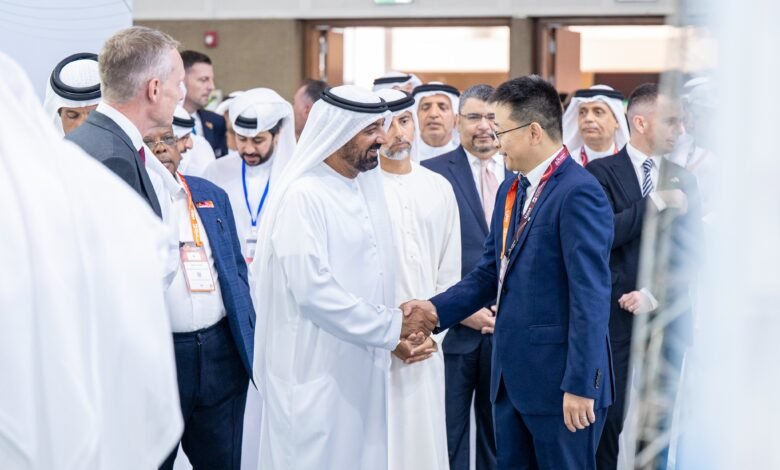
The tone was set at the opening ceremony on September 1, when His Highness Sheikh Ahmed bin Saeed Al Maktoum inaugurated the summit alongside His Excellency Suhail bin Mohammed Al Mazrouei, UAE Minister of Energy and Infrastructure. In his opening remarks, Minister Al Mazrouei grounded the global energy conversation in concrete performance metrics. Pointing to the 5.6-gigawatt continuous clean capacity delivered by the Barakah Nuclear Energy Plant and the UAE’s ambitious single-site project combining 5.2 gigawatts of solar PV with 19 gigawatt-hours of battery storage, the Minister emphasized that zero-carbon power must deliver reliable, 24/7 industrial baseload to support long-term economic growth.
Solving the Grid Bottleneck: Heavy Hardware Takes Center Stage
Throughout the summit, the dominant topic across the exhibition floor was the urgent need to modernize aging electrical networks. As utility-scale solar and wind projects rapidly multiply worldwide, legacy transmission grids face severe congestion, threatening to leave gigawatts of clean electricity stranded far from industrial demand centers.
This infrastructure gap created an intense hardware rush over the past three days, with utility delegations competing for production capacity from major equipment manufacturers. Regional pioneer Red Sea Cables emerged as a major focal point, showcasing its 132-kilovolt High Voltage Cable line engineered to withstand extreme thermal stress and harsh desert soil conditions, offering a crucial component for inter-regional grid interconnections.
Simultaneously, municipal utilities faced mounting pressure to adopt eco-friendly distribution hardware. Industry leader Lucy Electric generated significant commercial traction with the launch of the Nuventura Nu1, a sustainable medium-voltage switchgear operating up to 36 kilovolts. By using primary dry air insulation instead of sulfur hexafluoride (SF6)—a greenhouse gas over 23,000 times more potent than carbon dioxide—the equipment allows utilities across Europe and the Middle East to future-proof their substations against tightening chemical regulations.
To support the rapid procurement of these physical grid assets, strategic MoUs were executed during the show involving leading industrial players like Siemens, Honeywell, Schneider Electric, and Hitachi Energy alongside financial institutions such as First Abu Dhabi Bank. These multi-party agreements establish structured equipment financing mechanisms that lower upfront capital barriers for public utilities in emerging markets.
Intelligence at the Edge: AI and Energy Storage Integration
With intermittent solar generation introducing rapid voltage swings into national grids, artificial intelligence has solidified its position as an essential tool for utility control centers.
Demonstrating this shift, manufacturers like Altamat Power Solutions Group presented robotics-assisted, AI-integrated control systems designed to modernize legacy backup thermal generation fleets. Operating on edge computing hardware, these automated systems monitor grid frequency in real time, throttling backup generators up or down in milliseconds to compensate for sudden dips in solar generation.
Software innovations were also celebrated during the event’s official proceedings. Solar asset management platform PVFARM received the Renewable Energy Innovation Award for its predictive plant modeling platform, which runs real-time algorithms to optimize panel angles, shade profiles, and cable routing during plant design, maximizing overall energy yield for equity investors.
These software platforms work hand-in-hand with multi-directional energy storage. Belgian power electronics developer CE+T Power was recognized with the Power Resilience Award during the Middle East Energy Innovation Awards for its multidirectional power converters. Operating at conversion efficiencies exceeding 96%, these advanced converters manage bidirectional energy flows between solar arrays, battery stacks, and industrial AC/DC loads, allowing heavy facilities and data centers to maintain continuous power quality while trading energy back into the grid.
Cross-Border Power Maps and Global Trade Corridors
Inside the Leadership Summit, energy diplomacy was framed around physical interconnections. Discussions surrounding the Gulf Cooperation Council Interconnection Authority (GCCIA) highlighted how shared transmission corridors allow member states to pool reserve power, manage peak summer air-conditioning loads, and optimize cross-border electricity trade.
Bringing an international perspective to grid expansion, Nigeria’s Federal Minister of Power, Joseph Olasunkanmi Tegbe, delivered a key address calling for direct investment partnerships between Gulf sovereign funds and African nations to develop high-voltage direct current (HVDC) transmission lines across Africa. Minister Tegbe emphasized that cross-border infrastructure is essential to eliminate energy poverty and power sustainable industrialization across the continent.
European delegations similarly focused on establishing secure energy import corridors, exploring long-term subsea interconnects to import clean electricity, green hydrogen, and green ammonia directly from the Middle East and North Africa.
The Lasting Impact of MEE 2026
As the final delegates prepare to depart Dubai this evening, the legacy of Middle East Energy 2026 is clear. The landmark 50th edition demonstrated that the Middle East has firmly established itself as a leading operational and financial engine for global energy infrastructure.
By pairing sovereign balance sheets with civil nuclear capacity, massive solar-plus-storage projects, AI grid management, and heavy hardware manufacturing, the region provided a practical model for balancing rapid decarbonization with uninterrupted grid reliability. The overarching lesson from MEE 2026 is unambiguous: the future of global energy will be defined by the physical infrastructure—the cables, switchgears, control algorithms, and battery arrays—built to keep the world reliably powered.