THE NEW GOLDEN FOLD: HOW SAUDI ARABIA IS UNLOCKING THE ARABIAN SHIELD TO POWER THE POST-OIL AGE

Extending across the western third of the Arabian Peninsula, an ancient Precambrian rock mass is emerging as the engine of Saudi Arabia’s post-oil economic, energy, and industrial strategy.
The Geological Foundation of Vision 2030
The Arabian Shield is an ancient crystalline basement of igneous and metamorphic rocks formed during the Precambrian period, between 550 million and 880 million years ago.Covering approximately 600,000 square kilometers across western Saudi Arabia, this geological formation holds one of the world’s most concentrated, underexplored assemblages of precious metals, critical energy transition minerals, and rare earth elements.
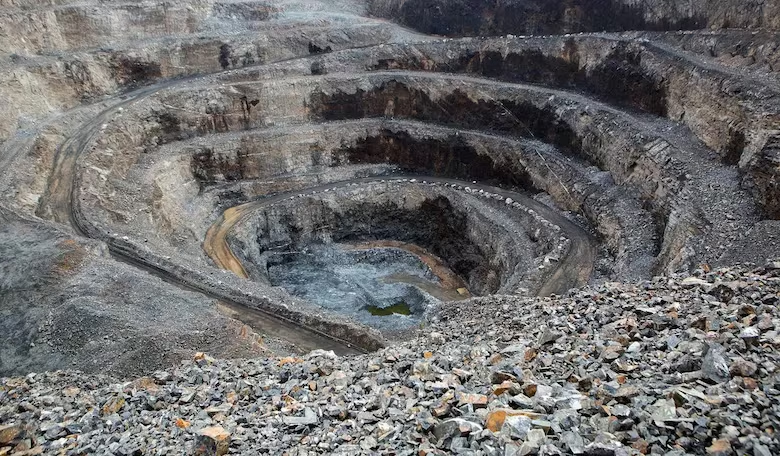
Under Saudi Arabia’s Vision 2030 economic diversification blueprint, the Kingdom has designated mining as the “third pillar” of national industry, standing directly alongside hydrocarbons and petrochemicals.
Riyadh’s push to explore and excavate the Arabian Shield—backed by an estimated $1.3 trillion to $2.5 trillion in untapped mineral endowment—is driven by imperative shifts in global energy, industrial supply chains, and sovereign security.
Defining the Arabian Shield: Structure and Mineral Architecture
The Arabian Shield was formed through arc-continent collisions, volcanic island accretion, and magmatic intrusions over hundreds of millions of years. When the Red Sea rifted open tens of millions of years ago, it separated the Arabian Shield from its twin—the Nubian Shield of Northeast Africa—leaving identical, highly mineralized volcanic belts on both sides.
Metallogenic Wealth and Resource Distribution
Geological surveys cataloging thousands of mineral occurrences across the Shield have revealed critical resource categories essential to modern industrial supply chains:
- Critical Energy Transition Metals:High-grade deposits of copper, nickel, zinc, lithium, cobalt, and chromium. Copper and nickel mineralization occurs primarily within Volcanogenic Massive Sulfide (VMS) deposits and mafic-ultramafic intrusive complexes across the western corridor.
- Precious Metals:Historical and modern gold and silver mineralization belts, anchored by tier-one deposits such as Mahd Ad Dhahab (“Cradle of Gold”), Ad Duwayhi, and the Mansourah-Massarah mining complex.
- Technology & Rare Metals:Post-collisional granites and pegmatites enriched with rare earth elements (REEs), tantalum, niobium, caesium, and zircon, which form the physical baseline for microelectronics, defense manufacturing, and specialized magnets.
- Industrial & Fertilizer Minerals:Adjoining sedimentary basins host massive bauxite deposits (feeding domestic aluminum refining) and northern phosphate basins holding billions of tonnes of phosphate ore used for global agricultural fertilizer production.
Strategic Drivers: Why Saudi Arabia is Digging the Shield
Riyadh’s aggressive acceleration of exploration licensing, airborne geophysics, and drilling programs across the Arabian Shield serves four strategic imperatives.
1. Powering the Global Energy Transition and Domestic Manufacturing
The rapid global adoption of electric vehicles (EVs), renewable energy grids, battery storage, and high-density compute infrastructure requires vast volumes of critical metals.
- Copper & Battery Supply Chains:Saudi Arabia’s massive renewable energy targets (50% solar and wind power mix by 2030) and electric vehicle manufacturing plans (such as Ceer Motors and Lucid Motors assembly units) require immediate local access to copper and nickel.
- Import Substitution:Sourcing critical metals natively from the Arabian Shield eliminates foreign supply-chain bottlenecks, allowing domestic battery gigafactories and solar frame manufacturers to source raw materials domestically.
2. Geothermal Energy and Zero-Carbon Baseload Power
Beyond solid minerals, the Arabian Shield provides a source of clean energy through geothermal capacity:
- High Heat-Generating Granites:Volcanically active zones and radiogenic granite formations stretching along the Red Sea coast (including the volcanic harrats) generate intense subsurface thermal anomalies.
- Baseload Green Energy: Saudi Aramco and state energy bodies are evaluating high-enthalpy geothermal reservoirs along the Shield to supply zero-carbon baseload electricity and thermal energy for local desalination units and green hydrogen processing plants without drawing on domestic oil or gas reserves.
3. Economic Diversification Away from Crude Hydrocarbons
While Saudi Aramco’s oil operations generate immediate fiscal cash flows, long-term global decarbonization poses a systemic threat to single-commodity state revenues. Digging the Arabian Shield converts subterranean natural resources into a perpetual industrial engine, targeting a direct GDP contribution from mining of 240 billion Saudi Riyals ($64 billion) by 2030.
4. Supply Chain Sovereignty and Geopolitical Arbitrage
Global trade fragmentation, maritime disruptions along key chokepoints, and intensifying resource competition between major economic blocs have highlighted the risks of foreign commodity dependency.By discovering, extracting, and processing critical minerals natively, Saudi Arabia positions itself as an indispensable regional processing hub connecting European, Asian, and African commodity corridors.
Structural Matrix: Oil Economy vs. Shield Mining Economy
| Vector | Legacy Hydrocarbon Sector | Arabian Shield Mining Sector |
| Geological Target | Sedimentary basins (Eastern Province) | Precambrian igneous & metamorphic rock (Western Shield) |
| Primary Output | Crude Oil, Natural Gas, Petrochemicals | Copper, Gold, Rare Earths, Geothermal Energy, Phosphate |
| Strategic Goal | Sovereign fiscal revenue & global oil market stabilization | Domestic industrialization, EV supply chains & tech manufacturing |
| Energy Role | Fossil fuel power generation & combustion exports | Materials for renewable energy transition & geothermal power |
| Key Champions | Saudi Aramco | Ma’aden, Saudi Geological Survey, Aramco Joint Ventures |
Modern Exploration Framework: AI and Digital Twins
To accelerate discovery timelines across 600,000 square kilometers of harsh desert terrain, Saudi Arabia has modernized its geological survey infrastructure:
- Digital Twins & AI Prospectivity:The Saudi Geological Survey (SGS) and national champions like Ma’aden utilize high-resolution satellite imagery, airborne magnetics, and machine-learning algorithms to map subterranean mineral deposits.These models generate predictive “heat maps” that guide precision exploratory drilling, cutting exploration timelines and minimizing land disturbance.
- Regulatory Overhaul:A updated Mining Investment Law reduced corporate tax hurdles, established clear licensing workflows, and created transparent regulatory frameworks, attracting international mining giants and major exploration consortia to the Shield.
The Arabian Shield represents a structural shift in Saudi Arabia’s asset base. By tapping into this ancient geological reservoir, the Kingdom is actively converting its subterranean mineral wealth into the physical foundation required to build a diversified, high-tech, and energy-resilient industrial economy.