EARTH, OLIVES, AND THE WEIGHT OF JERUSALEM: THE ENDURING LEGACY OF SLIMAN MANSOUR

The father of modern Palestinian visual art leaves behind six decades of work that transformed the concept of “sumud” into a tangible, world-defining aesthetic.
The Quiet Departure of a Giant
On the morning of August 24, 2026, Sliman Mansour, the undisputed patriarch of contemporary Palestinian visual culture, passed away in Jerusalem at the age of 79. His family confirmed his death at Al-Makassed Hospital, closing a profound chapter in the history of Middle Eastern art.
“To the world, he leaves behind a life filled with beauty, memory, and a legacy that will continue to live through all those he touched,” his family wrote in a public tribute. “But to us, we lost a father, our source of love, strength, and home.”
For more than half a century, Mansour did not merely paint the Palestinian experience; he gave visual form to a nation’s collective consciousness. At a time when physical land was being systematically carved up, Mansour used oil, clay, mud, and traditional embroidery patterns (tatreez) to construct an unassailable artistic homeland.
From the iconic imagery of a porter bearing the city of Jerusalem on his back to revolutionary mud sculptures made during the First Intifada, Mansour elevated the cultural concept of sumud (steadfast resilience) from a political slogan into an international visual language.
The Making of a Polymath: From Birzeit to Bezalel
Born in 1947 in Birzeit, north of Ramallah, just months before the seismic displacement of the Nakba, Mansour came of age during a period of profound historical rupture. Raised partly in a Lutheran boarding school for orphans in Bethlehem after his father died when he was four, his earliest artistic instincts were shaped by the rural landscapes of the West Bank and his grandmother, Salma, a potter who built earthenware ovens (tabouns) using local soil.
In 1968, Mansour enrolled at the prestigious Bezalel Academy of Arts and Design in West Jerusalem. There, Western instructors pushed him toward abstract expressionism. Mansour resisted. He recognized that for a displaced people, abstract minimalism was a luxury; what his community required was direct, legible, and unyielding representation.
He pivoted to a rigorous figurative realism, anchoring his canvases in ordinary rural life: olive harvesters, women in traditional embroidered robes, rugged limestone hills, and figures rooted to the earth like ancient flora.
The Masterpieces: Carrying the Camel of Hardships
In 1973, Mansour painted a work that would define Arab visual culture for generations: Jamal Al-Mahamel (The Camel of Hardships).
The painting depicts an elderly Palestinian porter, veins bulging and muscles strained under the weight of an eye-shaped globe tied to his back with a thick rope. Embedded inside the globe is the historic cityscape of Jerusalem, centered around the Dome of the Rock.
The image resonated far beyond fine art galleries. Printed as posters, reproduced on keychains, and hung in living rooms from Ramallah to Chicago, Beirut, and London, Jamal Al-Mahamel became the universal emblem of exile, displacement, and the unyielding burden of memory.
Censorship, Primary Colors, and the New Visions Collective
As Mansour’s influence grew, his studio became a focal point of cultural confrontation. In 1980, alongside fellow artists Nabil Anani and Issam Badr, Mansour co-founded Gallery 79 in Ramallah—the first independent space dedicated to Palestinian visual arts.
The Israeli military routinely raided the gallery, seizing canvases and issuing bans on politically charged imagery. During one infamous confrontation, military officials informed the artists that they were forbidden from painting the Palestinian flag. When Badr asked what would happen if an artist painted a flower containing red, green, black, and white, the officer replied that any work combining those four primary colors would be confiscated.
Instead of silencing the artists, the restriction sparked creative subversion.
When the First Intifada broke out in 1987, Mansour co-founded the New Visions (Al-Ru’ya Al-Jadida) collective alongside Vera Tamari, Tayseer Barakat, and Nabil Anani. The collective issued a manifesto calling on all artists to completely boycott Israeli-supplied canvases, oil paints, and commercial tools.
Mansour turned directly to the soil. Channeling his childhood memories of his grandmother’s pottery, he began mixing local mud, straw, henna, wood, and natural dyes to create textured, tactile reliefs. The material became the message: even if access to paint was severed, the land itself would supply the medium. As the mud dried and cracked on canvas, it mimicked the parched earth of drought and the resilience of a people bound to their geography.
Institutional Architect and Cultural Custodian
Mansour understood that individual talent was insufficient without lasting infrastructure. Throughout his life, he dedicated his energy to building cultural institutions across Jerusalem and the West Bank.
He served as president of the League of Palestinian Artists from 1986 to 1990, organizing clandestine exhibitions during years of intense political crackdown. In 1994, he co-founded the Al-Wasiti Art Center in East Jerusalem to preserve Arab art heritage and mentor emerging painters. A decade later, in 2004, he helped establish the International Academy of Art Palestine, the first formal degree-granting art academy in the West Bank, serving as acting director to train subsequent generations.
The Earth Returns to the Earth
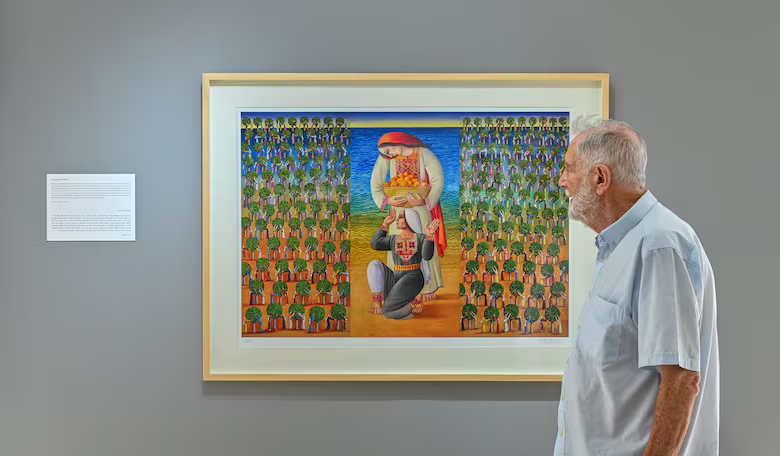
In his later years, working from his quiet studio in Ramallah, Mansour’s brushwork turned reflective. He painted expansive olive groves bathed in Mediterranean light, women carrying baskets of oranges through lost orchards, and aged figures leaning gently against ancient stone walls.
His work never curdled into despair. It remained, until his final days, a quiet affirmation of human dignity and belonging.
When asked in a 2023 interview why he refused to leave Jerusalem despite decades of hardship, Mansour offered a response that summarizes his life’s work:
“Anything that is Palestinian, even just being here, breathing and thinking, is a sensitive matter… because they built their narrative around denying our existence. Our work—not only as painters, but as intellectuals—is simply to express that we are here.”
Sliman Mansour leaves behind a world transformed by his vision. He proved that while borders can be redrawn and cities occupied, an identity captured in mud, canvas, and conviction remains entirely indestructible.